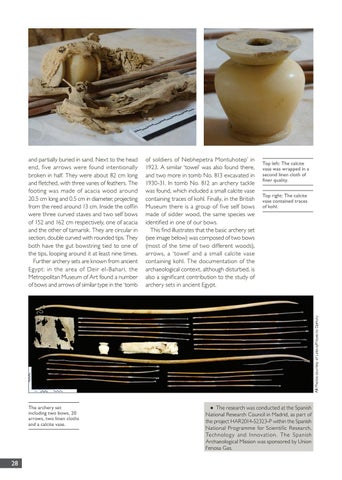
of soldiers of Nebhepetra Montuhotep’ in 1923. A similar ‘towel’ was also found there, and two more in tomb No. 813 excavated in 1930-31. In tomb No. 812 an archery tackle was found, which included a small calcite vase containing traces of kohl. Finally, in the British Museum there is a group of five self bows made of sidder wood, the same species we identified in one of our bows. This find illustrates that the basic archery set (see image below) was composed of two bows (most of the time of two different woods), arrows, a ‘towel’ and a small calcite vase containing kohl. The documentation of the archaeological context, although disturbed, is also a significant contribution to the study of archery sets in ancient Egypt.
Top left: The calcite vase was wrapped in a second linen cloth of finer quality. Top right: The calcite vase contained traces of kohl.
All Photos courtesy of Latova/Proyecto Djehuty
and partially buried in sand. Next to the head end, five arrows were found intentionally broken in half. They were about 82 cm long and fletched, with three vanes of feathers. The footing was made of acacia wood around 20.5 cm long and 0.5 cm in diameter, projecting from the reed around 13 cm. Inside the coffin were three curved staves and two self bows of 152 and 162 cm respectively, one of acacia and the other of tamarisk. They are circular in section, double curved with rounded tips. They both have the gut bowstring tied to one of the tips, looping around it at least nine times. Further archery sets are known from ancient Egypt: in the area of Deir el-Bahari, the Metropolitan Museum of Art found a number of bows and arrows of similar type in the ‘tomb
The archery set including two bows, 20 arrows, two linen cloths and a calcite vase.
28
• The research was conducted at the Spanish National Research Council in Madrid, as part of the project HAR2014-52323-P within the Spanish National Programme for Scientific Research, Technolog y and Innovation. The Spanish Archaeological Mission was sponsored by Union Fenosa Gas.