AN ARCHERY SET FROM DRA ABU EL-NAGA
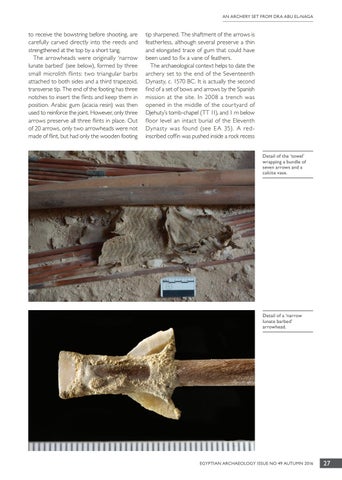
to receive the bowstring before shooting, are carefully carved directly into the reeds and strengthened at the top by a short tang. The arrowheads were originally ‘narrow lunate barbed’ (see below), formed by three small microlith flints: two triangular barbs attached to both sides and a third trapezoid, transverse tip. The end of the footing has three notches to insert the flints and keep them in position. Arabic gum (acacia resin) was then used to reinforce the joint. However, only three arrows preserve all three flints in place. Out of 20 arrows, only two arrowheads were not made of flint, but had only the wooden footing
tip sharpened. The shaftment of the arrows is featherless, although several preserve a thin and elongated trace of gum that could have been used to fix a vane of feathers. The archaeological context helps to date the archery set to the end of the Seventeenth Dynasty, c. 1570 BC. It is actually the second find of a set of bows and arrows by the Spanish mission at the site. In 2008 a trench was opened in the middle of the cour tyard of Djehuty’s tomb-chapel (TT 11), and 1 m below floor level an intact burial of the Eleventh Dynasty was found (see EA 35). A redinscribed coffin was pushed inside a rock recess Detail of the ‘towel’ wrapping a bundle of seven arrows and a calcite vase.
Detail of a ‘narrow lunate barbed’ arrowhead.
EGYPTIAN ARCHAEOLOGY ISSUE NO 49 AUTUMN 2016
27