THE ‘SLAUGHTERHOUSE ARCHIVE’ OF THE SETI TEMPLE AT ABYDOS
el Qa’ab, located at the mouth of the main wadi in Abydos, that contains the tombs of the first Egyptian rulers. With the rise of the Osiris cult at the end of the Old Kingdom, the cemetery, specifically the tomb of Djer, was reinterpreted as Osiris’ burial place. As such, the site became an impor tant pilgrimage destination, and it remained so throughout the rest of the pharaonic period. When arriving at Abydos, the first monument visitors see is the New Kingdom temple built by king Seti I. This structure is famous for its king list, inscribed with the names of 76 kings from the 1st to the 19th Dynasty, not including Seti himself. The temple, mainly built as a memorial to the king, was further dedicated to Osiris and Isis along with Ptah, Ptah-Sokar, Nefertem, Re-Horakhty, Amun, and Horus. Mariette first excavated it in 1869, followed by Calverley working there since the late 1920s. In more recent years, explorations have mainly focused on epigraphy, the theology and graffiti of the temple, in addition to smaller archaeological excavations. Most Egyptologists would probably assume that in a temple so thoroughly investigated, nothing could possibly remain to be discovered. However, while working as inspectors at Abydos in 2012, we were invited to photograph some scenes in the so-called Slaughterhouse. This section of the temple had been closed off for some time, and we expected to find it sitting unused, with nothing of interest inside apart from the wall decorations. Upon entering, however, we were surprised to discover that the southern rooms of the Slaughterhouse suite were not empty at all, but were filled to a height of about 1.5 m with a mix of old papers, ceramics, and stone fragments. Our first task was to move this mountain of material. Because there were clearly archaeological objects present, we decided to do a preliminary inventory to see what we were dealing with and quickly realized that we had a potential treasure trove on our hands. The ceramics included not only sherds ranging in date from Predynastic to Roman times, but also complete vessels. In addition, we counted more than a thousand stone pieces – statue and stela fragments, and blocks from the Seti I temple and from the temple of Ramesses II to the north. Many of these pieces still retain a large amount of colour, and are beautifully preserved. There are also a number of objects that post-
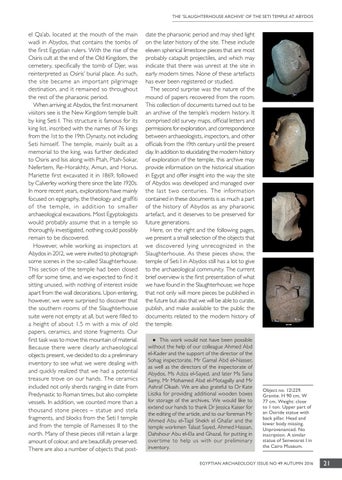
date the pharaonic period and may shed light on the later history of the site. These include eleven spherical limestone pieces that are most probably catapult projectiles, and which may indicate that there was unrest at the site in early modern times. None of these artefacts has ever been registered or studied. The second surprise was the nature of the mound of papers recovered from the room. This collection of documents turned out to be an archive of the temple’s modern history. It comprised old survey maps, official letters and permissions for exploration, and correspondence between archaeologists, inspectors, and other officials from the 19th century until the present day. In addition to elucidating the modern history of exploration of the temple, this archive may provide information on the historical situation in Egypt and offer insight into the way the site of Abydos was developed and managed over the last two centuries. The information contained in these documents is as much a part of the history of Abydos as any pharaonic artefact, and it deserves to be preserved for future generations. Here, on the right and the following pages, we present a small selection of the objects that we discovered lying unrecognized in the Slaughterhouse. As these pieces show, the temple of Seti I in Abydos still has a lot to give to the archaeological community. The current brief overview is the first presentation of what we have found in the Slaughterhouse; we hope that not only will more pieces be published in the future but also that we will be able to curate, publish, and make available to the public the documents related to the modern history of the temple.
• This work would not have been possible without the help of our colleague Ahmed Abd el-Kader and the support of the director of the Sohag inspectorate, Mr Gamal Abd el-Nasser, as well as the directors of the inspectorate of Abydos, Ms Aziza el-Sayed, and later Ms Sana Samy, Mr Mohamed Abd el-Motagally and Mr Ashraf Okash. We are also grateful to Dr Kate Liszka for providing additional wooden boxes for storage of the archives. We would like to extend our hands to thank Dr Jessica Kaiser for the editing of the article, and to our foreman Mr Ahmed Abu el-Tapl Shekh el Ghafar and the temple workmen Talaat Sayed, Ahmed Hassan, Dahshour Abu el-Ela and Ghazal, for putting in over time to help us with our preliminar y inventory.
Object no. 12\229. Granite. H 90 cm, W 77 cm. Weight: close to 1 ton. Upper part of an Osiride statue with back pillar. Head and lower body missing. Unprovenanced. No inscription. A similar statue of Senwosret I in the Cairo Museum.
EGYPTIAN ARCHAEOLOGY ISSUE NO 49 AUTUMN 2016
21