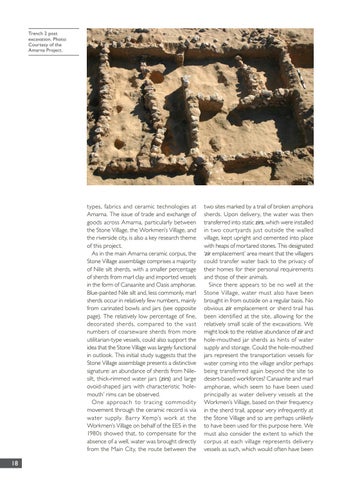
Trench 2 post excavation. Photo: Courtesy of the Amarna Project.
types, fabrics and ceramic technologies at Amarna. The issue of trade and exchange of goods across Amarna, particularly between the Stone Village, the Workmen’s Village, and the riverside city, is also a key research theme of this project. As in the main Amarna ceramic corpus, the Stone Village assemblage comprises a majority of Nile silt sherds, with a smaller percentage of sherds from marl clay and imported vessels in the form of Canaanite and Oasis amphorae. Blue-painted Nile silt and, less commonly, marl sherds occur in relatively few numbers, mainly from carinated bowls and jars (see opposite page). The relatively low percentage of fine, decorated sherds, compared to the vast numbers of coarseware sherds from more utilitarian-type vessels, could also support the idea that the Stone Village was largely functional in outlook. This initial study suggests that the Stone Village assemblage presents a distinctive signature: an abundance of sherds from Nilesilt, thick-rimmed water jars (zirs) and large ovoid-shaped jars with characteristic ‘holemouth’ rims can be observed. One approach to tracing commodity movement through the ceramic record is via water supply. Barr y Kemp’s work at the Workmen’s Village on behalf of the EES in the 1980s showed that, to compensate for the absence of a well, water was brought directly from the Main City, the route between the
18
two sites marked by a trail of broken amphora sherds. Upon delivery, the water was then transferred into static zirs, which were installed in two cour tyards just outside the walled village, kept upright and cemented into place with heaps of mortared stones. This designated ‘zir emplacement’ area meant that the villagers could transfer water back to the privacy of their homes for their personal requirements and those of their animals. Since there appears to be no well at the Stone Village, water must also have been brought in from outside on a regular basis. No obvious zir emplacement or sherd trail has been identified at the site, allowing for the relatively small scale of the excavations. We might look to the relative abundance of zir and hole-mouthed jar sherds as hints of water supply and storage. Could the hole-mouthed jars represent the transportation vessels for water coming into the village and/or perhaps being transferred again beyond the site to desert-based workforces? Canaanite and marl amphorae, which seem to have been used principally as water delivery vessels at the Workmen’s Village, based on their frequency in the sherd trail, appear very infrequently at the Stone Village and so are perhaps unlikely to have been used for this purpose here. We must also consider the extent to which the corpus at each village represents delivery vessels as such, which would often have been