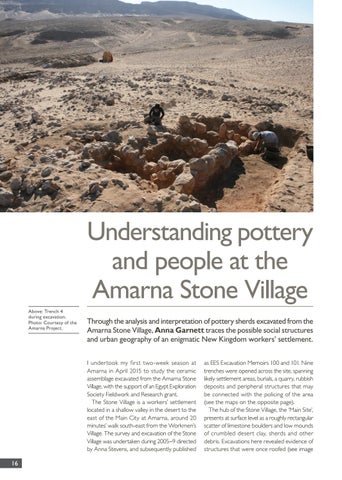
Understanding pottery and people at the Amarna Stone Village Above: Trench 4 during excavation. Photo: Courtesy of the Amarna Project.
Through the analysis and interpretation of pottery sherds excavated from the Amarna Stone Village, Anna Garnett traces the possible social structures and urban geography of an enigmatic New Kingdom workers’ settlement. I under took my first two-week season at Amarna in April 2015 to study the ceramic assemblage excavated from the Amarna Stone Village, with the support of an Egypt Exploration Society Fieldwork and Research grant. The Stone Village is a workers’ settlement located in a shallow valley in the desert to the east of the Main City at Amarna, around 20 minutes’ walk south-east from the Workmen’s Village. The survey and excavation of the Stone Village was undertaken during 2005–9 directed by Anna Stevens, and subsequently published
16
as EES Excavation Memoirs 100 and 101. Nine trenches were opened across the site, spanning likely settlement areas, burials, a quarry, rubbish deposits and peripheral structures that may be connected with the policing of the area (see the maps on the opposite page). The hub of the Stone Village, the ‘Main Site’, presents at surface level as a roughly rectangular scatter of limestone boulders and low mounds of crumbled desert clay, sherds and other debris. Excavations here revealed evidence of structures that were once roofed (see image