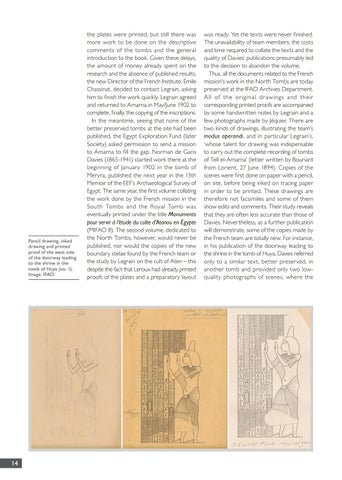
Pencil drawing, inked drawing and printed proof of the west side of the doorway leading to the shrine in the tomb of Huya (no. 1). Image: IFAO.
14
the plates were printed, but still there was more work to be done on the descriptive comments of the tombs and the general introduction to the book. Given these delays, the amount of money already spent on the research and the absence of published results, the new Director of the French Institute, Émile Chassinat, decided to contact Legrain, asking him to finish the work quickly. Legrain agreed and returned to Amarna in May/June 1902 to complete, finally, the copying of the inscriptions. In the meantime, seeing that none of the better preserved tombs at the site had been published, the Egypt Exploration Fund (later Society) asked permission to send a mission to Amarna to fill the gap. Norman de Garis Davies (1865-1941) started work there at the beginning of January 1902 in the tomb of Meryra, published the next year in the 13th Memoir of the EEF’s Archaeological Survey of Egypt. The same year, the first volume collating the work done by the French mission in the South Tombs and the Royal Tomb was eventually printed under the title Monuments pour servir à l’étude du culte d’Atonou en Égypte (MIFAO 8). The second volume, dedicated to the North Tombs, however, would never be published, nor would the copies of the new boundary stelae found by the French team or the study by Legrain on the cult of Aten – this despite the fact that Leroux had already printed proofs of the plates and a preparatory layout
was ready. Yet the texts were never finished. The unavailability of team members, the costs and time required to collate the texts and the quality of Davies’ publications presumably led to the decision to abandon the volume. Thus, all the documents related to the French mission’s work in the North Tombs are today preserved at the IFAO Archives Department. All of the or iginal dr awings and their corresponding printed proofs are accompanied by some handwritten notes by Legrain and a few photographs made by Jéquier. There are two kinds of drawings, illustrating the team’s modus operandi, and in particular Legrain’s, ‘whose talent for drawing was indispensable to carry out the complete recording of tombs of Tell el-Amarna’ (letter written by Bouriant from Lorient, 27 June 1894). Copies of the scenes were first done on paper with a pencil, on site, before being inked on tracing paper in order to be printed. These drawings are therefore not facsimiles and some of them show edits and comments. Their study reveals that they are often less accurate than those of Davies. Nevertheless, as a further publication will demonstrate, some of the copies made by the French team are totally new. For instance, in his publication of the doorway leading to the shrine in the tomb of Huya, Davies referred only to a similar text, better preserved, in another tomb and provided only two lowquality photographs of scenes, where the