BOURIANT AT AMARNA: AN ALMOST FORGOTTEN FRENCH MISSION
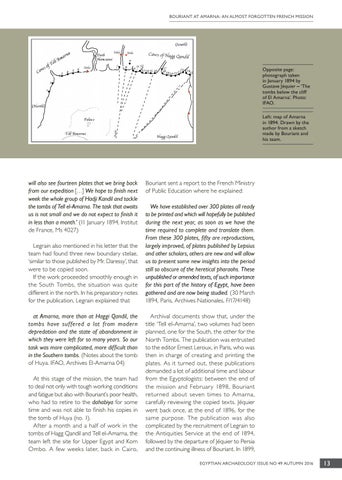
Opposite page: photograph taken in January 1894 by Gustave Jéquier – ‘The tombs below the cliff of El Amarna’. Photo: IFAO. Left: map of Amarna in 1894. Drawn by the author from a sketch made by Bouriant and his team.
will also see fourteen plates that we bring back from our expedition […] We hope to finish next week the whole group of Hadji Kandil and tackle the tombs of Tell el-Amarna. The task that awaits us is not small and we do not expect to finish it in less than a month.’ (11 January 1894, Institut de France, Ms 4027) Legrain also mentioned in his letter that the team had found three new boundary stelae, ‘similar to those published by Mr. Daressy’, that were to be copied soon. If the work proceeded smoothly enough in the South Tombs, the situation was quite different in the north. In his preparatory notes for the publication, Legrain explained that at Amarna, more than at Haggi Qandil, the tombs have suf fered a lot from modern depredation and the state of abandonment in which they were left for so many years. So our task was more complicated, more difficult than in the Southern tombs. (Notes about the tomb of Huya. IFAO, Archives El-Amarna 04) At this stage of the mission, the team had to deal not only with tough working conditions and fatigue but also with Bouriant’s poor health, who had to retire to the dahabiya for some time and was not able to finish his copies in the tomb of Huya (no. 1). After a month and a half of work in the tombs of Hagg Qandil and Tell el-Amarna, the team left the site for Upper Egypt and Kom Ombo. A few weeks later, back in Cairo,
Bouriant sent a report to the French Ministry of Public Education where he explained: We have established over 300 plates all ready to be printed and which will hopefully be published during the next year, as soon as we have the time required to complete and translate them. From these 300 plates, fifty are reproductions, largely improved, of plates published by Lepsius and other scholars, others are new and will allow us to present some new insights into the period still so obscure of the heretical pharaohs. These unpublished or amended texts, of such importance for this part of the history of Egypt, have been gathered and are now being studied. (30 March 1894, Paris, Archives Nationales, F/17/4148) Archival documents show that, under the title ‘Tell el-Amarna’, two volumes had been planned, one for the South, the other for the North Tombs. The publication was entrusted to the editor Ernest Leroux, in Paris, who was then in charge of creating and printing the plates. As it turned out, these publications demanded a lot of additional time and labour from the Egyptologists: between the end of the mission and February 1898, Bouriant returned about seven times to Amarna, carefully reviewing the copied texts. Jéquier went back once, at the end of 1896, for the same purpose. The publication was also complicated by the recruitment of Legrain to the Antiquities Service at the end of 1894, followed by the departure of Jéquier to Persia and the continuing illness of Bouriant. In 1899, EGYPTIAN ARCHAEOLOGY ISSUE NO 49 AUTUMN 2016
13