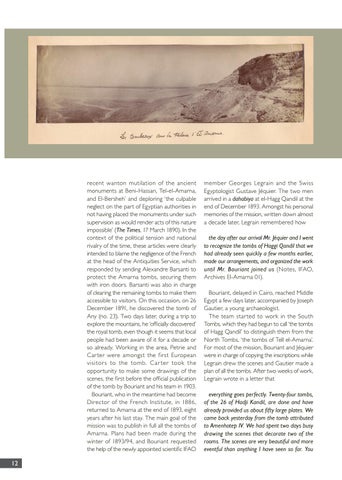
recent wanton mutilation of the ancient monuments at Beni-Hassan, Tel-el-Amarna, and El-Bersheh’ and deploring ‘the culpable neglect on the part of Egyptian authorities in not having placed the monuments under such supervision as would render acts of this nature impossible’ (The Times, 17 March 1890). In the context of the political tension and national rivalry of the time, these articles were clearly intended to blame the negligence of the French at the head of the Antiquities Service, which responded by sending Alexandre Barsanti to protect the Amarna tombs, securing them with iron doors. Barsanti was also in charge of clearing the remaining tombs to make them accessible to visitors. On this occasion, on 26 December 1891, he discovered the tomb of Any (no. 23). Two days later, during a trip to explore the mountains, he ‘officially discovered’ the royal tomb, even though it seems that local people had been aware of it for a decade or so already. Working in the area, Petrie and Car ter were amongst the first European visitor s to the tomb. Car ter took the opportunity to make some drawings of the scenes, the first before the official publication of the tomb by Bouriant and his team in 1903. Bouriant, who in the meantime had become Director of the French Institute, in 1886, returned to Amarna at the end of 1893, eight years after his last stay. The main goal of the mission was to publish in full all the tombs of Amarna. Plans had been made during the winter of 1893/94, and Bouriant requested the help of the newly appointed scientific IFAO
12
member Georges Legrain and the Swiss Egyptologist Gustave Jéquier. The two men arrived in a dahabiya at el-Hagg Qandil at the end of December 1893. Amongst his personal memories of the mission, written down almost a decade later, Legrain remembered how the day after our arrival Mr. Jéquier and I went to recognize the tombs of Haggi Qandil that we had already seen quickly a few months earlier, made our arrangements, and organized the work until Mr. Bouriant joined us (Notes, IFAO, Archives El-Amarna 01). Bouriant, delayed in Cairo, reached Middle Egypt a few days later, accompanied by Joseph Gautier, a young archaeologist. The team star ted to work in the South Tombs, which they had begun to call ‘the tombs of Hagg Qandil’ to distinguish them from the North Tombs, ‘the tombs of Tell el-Amarna’. For most of the mission, Bouriant and Jéquier were in charge of copying the inscriptions while Legrain drew the scenes and Gautier made a plan of all the tombs. After two weeks of work, Legrain wrote in a letter that everything goes perfectly. Twenty-four tombs, of the 26 of Hadji Kandil, are done and have already provided us about fifty large plates. We came back yesterday from the tomb attributed to Amenhotep IV. We had spent two days busy drawing the scenes that decorate two of the rooms. The scenes are very beautiful and more eventful than anything I have seen so far. You