BOURIANT AT AMARNA: AN ALMOST FORGOTTEN FRENCH MISSION
might have provided precise information about the owner – the Egyptologist discovered more inscriptions containing the name Mahu. Bouriant spent the rest of day in the tomb, recording the texts, which were published in 1889 together with the rest of the results obtained during those two days, in the first volume of the Mémoires de la Mission Archéologique Française (MMAF). This very short mission was followed by a somewhat longer one two years later. On 6 December 1884, Bouriant left Cairo with Maspero on board a steamer to reach Upper Egypt, where the two men had planned to work for several months. On their way, they visited a number of sites before mooring on the bank of the modern village of el-Hagg Qandil, located towards the southern end of the Amarna plain. From there, Bouriant hoped to be lucky enough to find new tombs dating from the reign of Akhenaten. Between midDecember 1884 and Januar y 1885, he continued his work in the South Tombs. He discovered about 20 tombs but none of them preserved any inscriptions, except one (no. 18), where he copied the remains of some
hieroglyphs situated on the doorway. Given these disappointing results, Bouriant wanted to concentrate his research on the northern end of the site. However, the ghaffirs (guards) refused to lead him and Maspero there, arguing that this part of the site was not safe after a number of murders had happened there shortly before. For a second time, Bouriant was forced to end his mission before achieving his goals. Never theless, he left Amarna convinced that future research remained to be done around ‘the North group or towards the centre itself of the cliff’. During the following years, other missions began research at Amarna. Flinders Petrie was the first to obtain permission from Eugène Grébaut, Director of the Antiquities Service, to work exclusively in the ancient city, not in the tombs. The British Egyptologist worked in several areas of the settlement from October 1891 to April 1892 and undertook a survey in the deser t, completed by the 18-year-old Howard Car ter – Petrie being unable to continue due to a foot injury. At the time, English newspapers, in particular The Times, published several ar ticles mentioning ‘the
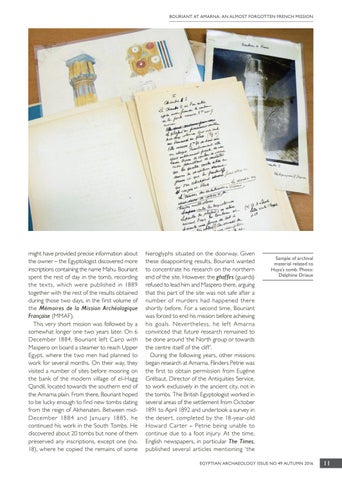
Sample of archival material related to Huya’s tomb. Photo: Delphine Driaux
EGYPTIAN ARCHAEOLOGY ISSUE NO 49 AUTUMN 2016
11