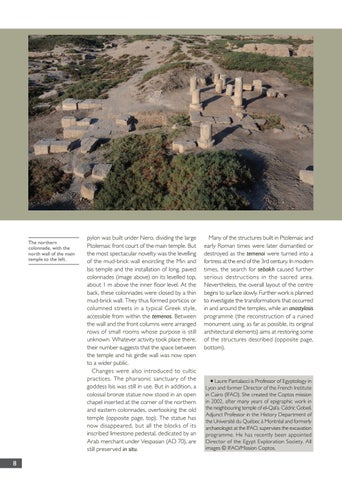
The northern colonnade, with the north wall of the main temple to the left.
8
pylon was built under Nero, dividing the large Ptolemaic front court of the main temple. But the most spectacular novelty was the levelling of the mud-brick wall encircling the Min and Isis temple and the installation of long, paved colonnades (image above) on its levelled top, about 1 m above the inner floor level. At the back, these colonnades were closed by a thin mud-brick wall. They thus formed porticos or columned streets in a typical Greek style, accessible from within the temenos. Between the wall and the front columns were arranged rows of small rooms whose purpose is still unknown. Whatever activity took place there, their number suggests that the space between the temple and his girdle wall was now open to a wider public. Changes were also introduced to cultic practices. The pharaonic sanctuary of the goddess Isis was still in use. But in addition, a colossal bronze statue now stood in an open chapel inserted at the corner of the northern and eastern colonnades, overlooking the old temple (opposite page, top). The statue has now disappeared, but all the blocks of its inscribed limestone pedestal, dedicated by an Arab merchant under Vespasian (AD 70), are still preserved in situ.
Many of the structures built in Ptolemaic and early Roman times were later dismantled or destroyed as the temenoi were turned into a fortress at the end of the 3rd century. In modern times, the search for sebakh caused further serious destructions in the sacred area. Nevertheless, the overall layout of the centre begins to surface slowly. Further work is planned to investigate the transformations that occurred in and around the temples, while an anastylosis programme (the reconstruction of a ruined monument using, as far as possible, its original architectural elements) aims at restoring some of the structures described (opposite page, bottom).
• Laure Pantalacci is Professor of Egyptology in Lyon and former Director of the French Institute in Cairo (IFAO). She created the Coptos mission in 2002, after many years of epigraphic work in the neighbouring temple of el-Qal’a. Cédric Gobeil, Adjunct Professor in the History Department of the Université du Québec à Montréal and formerly archaeologist at the IFAO, supervises the excavation programme. He has recently been appointed Director of the Egypt Exploration Society. All images © IFAO/Mission Coptos.