EGYPTIAN
ARCHAEOLOGY
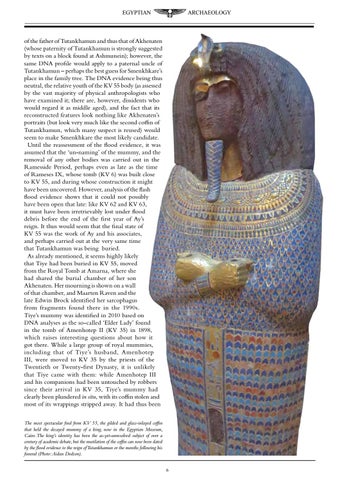
of the father of Tutankhamun and thus that of Akhenaten (whose paternity of Tutankhamun is strongly suggested by texts on a block found at Ashmunein); however, the same DNA profile would apply to a paternal uncle of Tutankhamun – perhaps the best guess for Smenkhkare’s place in the family tree. The DNA evidence being thus neutral, the relative youth of the KV 55 body (as assessed by the vast majority of physical anthropologists who have examined it; there are, however, dissidents who would regard it as middle aged), and the fact that its reconstructed features look nothing like Akhenaten’s portraits (but look very much like the second coffin of Tutankhamun, which many suspect is reused) would seem to make Smenkhkare the most likely candidate. Until the reassessment of the flood evidence, it was assumed that the ‘un-naming’ of the mummy, and the removal of any other bodies was carried out in the Ramesside Period, perhaps even as late as the time of Rameses IX, whose tomb (KV 6) was built close to KV 55, and during whose construction it might have been uncovered. However, analysis of the flash flood evidence shows that it could not possibly have been open that late: like KV 62 and KV 63, it must have been irretrievably lost under flood debris before the end of the first year of Ay’s reign. It thus would seem that the final state of KV 55 was the work of Ay and his associates, and perhaps carried out at the very same time that Tutankhamun was being buried. As already mentioned, it seems highly likely that Tiye had been buried in KV 55, moved from the Royal Tomb at Amarna, where she had shared the burial chamber of her son Akhenaten. Her mourning is shown on a wall of that chamber, and Maarten Raven and the late Edwin Brock identified her sarcophagus from fragments found there in the 1990s. Tiye’s mummy was identified in 2010 based on DNA analyses as the so-called ‘Elder Lady’ found in the tomb of Amenhotep II (KV 35) in 1898, which raises interesting questions about how it got there. While a large group of royal mummies, including that of Tiye’s husband, Amenhotep III, were moved to KV 35 by the priests of the Twentieth or Twenty-first Dynasty, it is unlikely that Tiye came with them: while Amenhotep III and his companions had been untouched by robbers since their arrival in KV 35, Tiye’s mummy had clearly been plundered in situ, with its coffin stolen and most of its wrappings stripped away. It had thus been The most spectacular find from KV 55, the gilded and glass-inlayed coffin that held the decayed mummy of a king, now in the Egyptian Museum, Cairo. The king’s identity has been the as-yet-unresolved subject of over a century of academic debate, but the mutilation of the coffin can now been dated by the flood evidence to the reign of Tutankhamun or the months following his funeral (Photo: Aidan Dodson). 6