EGYPTIAN
ARCHAEOLOGY
placement of items in the tomb (the reverse of what might have been expected) perhaps suggesting a re-burial. If so, where was their original tomb and why were they moved? Perhaps they may have been originally buried in their home town of Akhmim, or perhaps under the tomb-chapel that they may have had on the other side of the Theban mountain, like other dignitaries of the time – theirs may well be one of the countless ruined, nameless or lost tombs there. How typical would a tomb such as KV 63, if it is indeed Tutankhamun’s embalming cache (probably the more likely option), have been? Clearly, all those buried in the Valley will have been embalmed, with a similar tithe of resulting debris – but no direct parallels have thus far been located near other tombs in the Valley. The solution is probably to be found in the small size of Tutankhamun’s tomb, clearly a modest enlargement of a private tomb of a kind not uncommon in the Valley, a good example being that occupied by Yuya and Tjuiu’s KV 46. In larger tombs, there will have been ample space for such material, but most certainly not in the restricted layout of KV 62. The desire to nevertheless keep the embalming material close to the king’s body would thus have been fulfilled by placing it in a shaft-tomb nearby. By virtue of the flood, both KV 62 and KV 63 survived intact (or in the case of KV 62, almost intact, having been entered and lightly robbed within days of the interment) until modern times. It is now clear that the same flood was also responsible for another tomb being concealed from sight soon after the death of Tutankhamun until the 20th century ad: the notorious KV 55.
This sepulchre was found by the American businessmanexcavator Theodore M. Davis in January 1907. It contained a decayed mummy in a gilded and glassinlaid coffin (adapted for a king from a piece originally made for Kiya, junior wife of Akhenaten) from which all names and the face had been removed, a dismantled funerary shrine of Queen Tiye, wife of Amenhotep III and mother of Akhenaten (apparently in the process of being taken out of the tomb), four canopic jars (adapted for a king from a set made for Kiya), four ‘magic bricks’ of Akhenaten, and various assorted items. The theories woven to explain this deposit and identify its ultimate and former occupants cover hundreds of pages of books and periodicals, with little consensus, although the mummy is generally viewed either as Akhenaten himself or his ephemeral co-regent, Smenkhkare. The former presence of Queen Tiye’s body in the tomb has often been postulated on the basis of the presence of the shrine, and its later removal (at the time the remaining body was deprived of its identity) on the basis of the abortive removal of the shrine. In any case, there seems broad agreement that, whatever happened to it subsequently, the deposit originally represented the place where at least some of the members of the royal family who had died and been buried at Amarna were interred after the abandonment of Amarna as a capital city and dynastic cemetery during the first part of the reign of Tutankhamun – often placed in his third or fourth regnal year. DNA analyses, whose results were published in 2010, were announced as showing that the KV 55 body was that
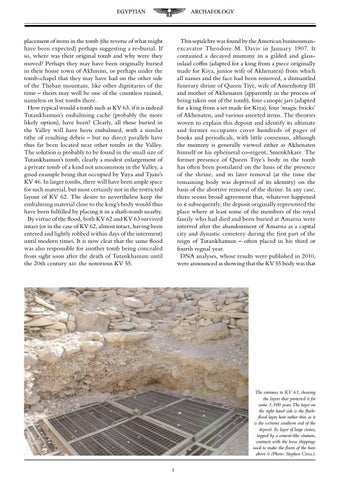
The entrance to KV 63, showing the layers that protected it for some 3,300 years.The layer on the right hand side is the flashflood layer, here rather thin as it is the extreme southern end of the deposit. Its layer of large stones, topped by a cement-like stratum, contrasts with the loose chippings used to make the floors of the huts above it (Photo: Stephen Cross.). 5