EGYPTIAN
ARCHAEOLOGY
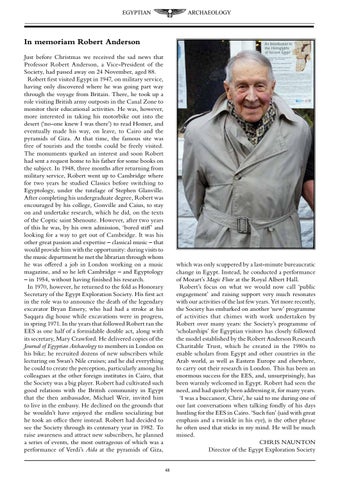
In memoriam Robert Anderson Just before Christmas we received the sad news that Professor Robert Anderson, a Vice-President of the Society, had passed away on 24 November, aged 88. Robert first visited Egypt in 1947, on military service, having only discovered where he was going part way through the voyage from Britain. There, he took up a role visiting British army outposts in the Canal Zone to monitor their educational activities. He was, however, more interested in taking his motorbike out into the desert (‘no-one knew I was there’) to read Homer, and eventually made his way, on leave, to Cairo and the pyramids of Giza. At that time, the famous site was free of tourists and the tombs could be freely visited. The monuments sparked an interest and soon Robert had sent a request home to his father for some books on the subject. In 1948, three months after returning from military service, Robert went up to Cambridge where for two years he studied Classics before switching to Egyptology, under the tutelage of Stephen Glanville. After completing his undergraduate degree, Robert was encouraged by his college, Gonville and Caius, to stay on and undertake research, which he did, on the texts of the Coptic saint Shenoute. However, after two years of this he was, by his own admission, ‘bored stiff’ and looking for a way to get out of Cambridge. It was his other great passion and expertise – classical music – that would provide him with the opportunity: during visits to the music department he met the librarian through whom he was offered a job in London working on a music magazine, and so he left Cambridge – and Egyptology – in 1954, without having finished his research. In 1970, however, he returned to the fold as Honorary Secretary of the Egypt Exploration Society. His first act in the role was to announce the death of the legendary excavator Bryan Emery, who had had a stroke at his Saqqara dig house while excavations were in progress, in spring 1971. In the years that followed Robert ran the EES as one half of a formidable double act, along with its secretary, Mary Crawford. He delivered copies of the Journal of Egyptian Archaeology to members in London on his bike; he recruited dozens of new subscribers while lecturing on Swan’s Nile cruises; and he did everything he could to create the perception, particularly among his colleagues at the other foreign institutes in Cairo, that the Society was a big player. Robert had cultivated such good relations with the British community in Egypt that the then ambassador, Michael Weir, invited him to live in the embassy. He declined on the grounds that he wouldn’t have enjoyed the endless socializing but he took an office there instead. Robert had decided to see the Society through its centenary year in 1982. To raise awareness and attract new subscribers, he planned a series of events, the most outrageous of which was a performance of Verdi’s Aida at the pyramids of Giza,
which was only scuppered by a last-minute bureaucratic change in Egypt. Instead, he conducted a performance of Mozart’s Magic Flute at the Royal Albert Hall. Robert’s focus on what we would now call ‘public engagement’ and raising support very much resonates with our activities of the last few years. Yet more recently, the Society has embarked on another ‘new’ programme of activities that chimes with work undertaken by Robert over many years: the Society’s programme of ‘scholarships’ for Egyptian visitors has closely followed the model established by the Robert Anderson Research Charitable Trust, which he created in the 1980s to enable scholars from Egypt and other countries in the Arab world, as well as Eastern Europe and elsewhere, to carry out their research in London. This has been an enormous success for the EES, and, unsurprisingly, has been warmly welcomed in Egypt. Robert had seen the need, and had quietly been addressing it, for many years. ‘I was a buccaneer, Chris’, he said to me during one of our last conversations when talking fondly of his days hustling for the EES in Cairo. ‘Such fun’ (said with great emphasis and a twinkle in his eye), is the other phrase he often used that sticks in my mind. He will be much missed. CHRIS NAUNTON Director of the Egypt Exploration Society 48