EGYPTIAN
ARCHAEOLOGY
The Valley of the Kings in the reign of Tutankhamun Aidan Dodson and Stephen Cross look at the emerging picture provided by new data regarding the burial of Tutankhamun and the history of the area around his tomb. Over the past few months, the tomb of Tutankhamun has once again become centre-stage through the potential for new chambers in the sepulchre (unresolved as we go to press). Also, in the last issue of Egyptian Archaeology, Earl Ertman and the late Otto Schaden presented a small gilded coffin from tomb KV 63 in the Valley of the Kings, found in 2005 during clearances in front of the tomb of the Nineteenth Dynasty king Amenmeses. It was the first tomb to be found in the Valley since KV 62 – the tomb of Tutankhamun. A 5 x 4 m unfinished chamber opened at the bottom of a 5 metre-deep shaft, it had never been entered since being closed by those who had left the material found there. The chamber contained seven wooden coff ins, including one child-sized and one a miniature example, plus 28 large storage jars. It soon became clear that none
of the coffins held mummies: rather they, and the jars, proved to contain feather pillows, some 175 kg of natron, and other material deriving from the embalming process. Such ‘embalming caches’ were found within the largely intact tombs of Maihirpri (KV 36) and Amenhotep III’s parents-in-law, Yuya and Tjuiu (KV 46), comprising respectively 13 and 52 large jars of the material, in the latter case placed in a pit at the far end of the burial chamber; 14 jars belonging to Merenptah were found outside his tomb (KV 8). Examples of such caches, found elsewhere, go back to at least the Eleventh Dynasty, and continue down to the Late Period. When KV 63 was f irst found, there was much uninformed speculation over whether – given that it was clear from the outset that the coffins were of late Eighteenth Dynasty date – the tomb might hold the
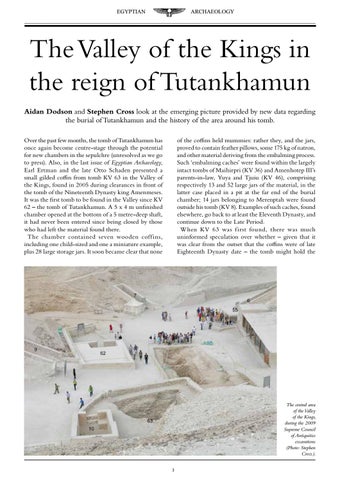
The central area of the Valley of the Kings, during the 2009 Supreme Council of Antiquities excavations (Photo: Stephen Cross.). 3