EGYPTIAN
ARCHAEOLOGY
Bookshelf
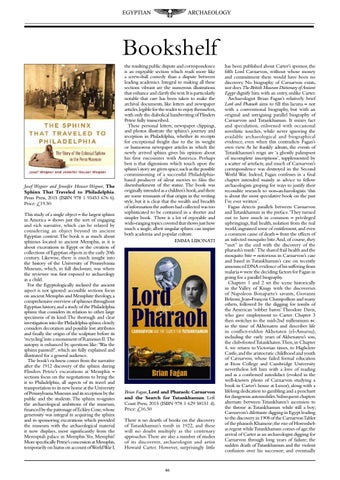
Josef Wegner and Jennifer Houser Wegner, The Sphinx That Traveled to Philadelphia. Penn Press, 2015 (ISBN 978 1 93453 676 6). Price: £19.50 This study of a single object – the largest sphinx in America – shows just the sort of engaging and rich narrative, which can be relayed by considering an object beyond its ancient Egyptian context. The book is as much about sphinxes located in ancient Memphis, as it is about excavations in Egypt or the creation of collections of Egyptian objects in the early 20th century. Likewise, there is much insight into the history of the University of Pennsylvania Museum, which, in full disclosure, was where the reviewer was first exposed to archaeology as a child. For the Egyptologically inclined the ancient aspect is not ignored: accessible sections focus on ancient Memphis and Memphite theology, a comprehensive overview of sphinxes throughout Egyptian history, and a study of the Philadelphia sphinx that considers its relation to other large specimens of its kind. The thorough and clear investigation into the Philadelphia sphinx closely considers decoration and possible lost attributes and finally the origin of the sculpture before its ‘recycling’ into a monument of Ramesses II. The autopsy is enhanced by questions like: ‘Was the sphinx painted?’, which are fully explained and illustrated for a general audience. The book’s richness comes from the narrative after the 1912 discovery of the sphinx during Flinders Petrie’s excavations at Memphis – sections focus on the negotiations to bring the it to Philadelphia, all aspects of its travel and transportation to its new home at the University of Pennsylvania Museum and its reception by the public and the students. The sphinx re-ignites the archaeological ambitions of the museum, financed by the patronage of Eckley Coxe, whose generosity was integral in acquiring the sphinx and in sponsoring excavations which provided the museum with the archaeological material it now displays, most significantly from the Merenptah palace in Memphis. Yes, Memphis! More specifically Petrie’s concession at Memphis, temporarily on hiatus on account of World War I,
the resulting public dispute and correspondence is an enjoyable section which reads more like a screw-ball comedy than a dispute between leading academics. Integral to making all these sections vibrant are the numerous illustrations that enhance and clarify the text. It is particularly notable that care has been taken to make the archival documents, like letters and newspaper articles, legible for the reader to enjoy themselves, with only the diabolical handwriting of Flinders Petrie fully transcribed. These personal letters, newspaper clippings, and photos illustrate the sphinx’s journey and reception in Philadelphia, whether its receipts for exceptional freight due to the its weight or humorous newspaper articles in which the newly arrived sphinx gives his opinion about his first encounter with America. Perhaps best is that digressions which touch upon the sphinx’s story are given space, such as the possible commissioning of a successful Philadelphiabased producer of silent movies to film the disembarkment of the statue. The book was originally intended as a children’s book, and there are some remnants of that origin in the writing style, but it is clear that the wealth and breadth of information the authors had collected was too sophisticated to be contained in a shorter and simpler book. There is a lot of enjoyable and wide-ranging topics covered that shows just how much a single, albeit singular sphinx can inspire both academia and popular culture. EMMA LIBONATI
Brian Fagan, Lord and Pharaoh: Carnarvon and the Search for Tutankhamun. Left Coast Press, 2015 (ISBN 978 1 629 58151 4). Price: £16.50 There is no dearth of books on the discovery of Tutankhamun’s tomb in 1922, and these will no doubt multiply as the centenary approaches. There are also a number of studies of its discoverer, archaeologist and artist Howard Carter. However, surprisingly little
46
has been published about Carter’s sponsor, the fifth Lord Carnarvon, without whose money and commitment there would have been no discovery. No biography of Carnarvon exists, nor does The British Museum Dictionary of Ancient Egypt dignify him with an entry, unlike Carter. Archaeologist Brian Fagan’s relatively brief Lord and Pharaoh aims to fill this lacuna – not with a conventional biography, but with an original and intriguing parallel biography of Carnarvon and Tutankhamun. It mixes fact and speculation, enlivened with occasional novelistic touches, while never ignoring the available archaeological and biographical evidence, even when this contradicts Fagan’s own view. As he frankly admits, the events of Tutankhamun’s reign are ‘a ghostly palimpsest of incomplete inscriptions’, supplemented by a scatter of artefacts; and much of Carnarvon’s correspondence was destroyed in the Second World War. Indeed, Fagan confesses in a final chapter intended mainly as advice to fellow archaeologists groping for ways to justify their recondite research to non-archaeologists: ‘this is about the most speculative book on the past I’ve ever written’. Fagan detects parallels between Carnarvon and Tutankhamun in the preface. ‘They turned out to have much in common – privileged upbringings, frail health, isolation from the real world, ingrained sense of entitlement, and even a common cause of death – from the effects of an infected mosquito bite. And, of course, they “met” in the end with the discovery of the pharaoh’s tomb.’ The shared frail health and the mosquito bite – notorious in Carnarvon’s case and based in Tutankhamun’s case on recently announced DNA evidence of his suffering from malaria – were the deciding factors for Fagan in going for a parallel biography. Chapters 1 and 2 set the scene historically in the Valley of Kings with the discoveries of Napoleon Bonaparte’s savants, Giovanni Belzoni, Jean-François Champollion and many others, followed by the digging for tombs of the American ‘robber baron’ Theodore Davis, who gave employment to Carter. Chapter 3 then switches to the mid-2nd millennium bc in the time of Akhenaten and describes life in conflict-ridden Akhetaten (el-Amarna), including the early years of Akhenaten’s son, the club-footed Tutankhaten.Then, in Chapter 4, we return to Victorian times, to Highclere Castle, and the aristocratic childhood and youth of Carnarvon, whose failed formal education at Eton College and Cambridge University nevertheless left him with a love of reading and as a confirmed autodidact (evoked in the well-known photo of Carnarvon studying a book in Carter’s house at Luxor), along with a lifelong dedication to gambling and a penchant for dangerous automobiles. Subsequent chapters alternate between Tutankhaten’s ascension to the throne as Tutankhamun while still a boy; Carnarvon’s dilettante digging in Egypt leading to the discovery in 1908 of the Carnarvon Tablet of the pharaoh Khamose; the rise of Horemheb as regent while Tutankhamun comes of age; the arrival of Carter as an archaeologist digging for Carnarvon through long years of failure; the sudden death of Tutankhamun and the violent confusion over his successor; and eventually