EGYPTIAN
ARCHAEOLOGY
Hatshepsut was neither the first nor the last woman ruling in Egypt. Other queens who were ruling independently do not appear to have been erased from history in this manner, simply because they were women. Why Thutmose III wanted to blot out the name of Hatshepsut as a ruler many years after her reign is still contested. Maybe further work in the speos will reveal more evidence concerning the queen’s damnatio memoriae.
Keyword: Gebelein Gebelein is located some 30 km south of Thebes, on the western bank of the Nile, and was capital of a nome during the Ptolemaic Period. It is named after its two hills: Gebelein in Arabic, or Inr-ti (‘Two Rocks’) in ancient Egyptian. The site was also known by its Greek names as Aphroditopolis and Pathyris. Already mentioned in the Déscription de l’Egypte of 1804, archaeological work there only began in 1884. G. W. Fraser and M. W. Blackburn excavated at the site for the Egypt Exploration Fund in 1893. On the eastern hill, the remains of a Hathor temple have been found, dating back primarily to the First Intermediate Period and Middle Kingdom and still in existence in Roman times. The western hill is the site of a partially explored cemetery, in use since the Predynastic Period. Furnishings of the Tenth Dynasty tomb of the nomarch and the high priest Ini found there are now in the Museo Egizio in Turin, as are contents of the First Intermediate Period tomb of the royal treasurer, an army commander Ini and his wife Neferu.
Measuring and documenting sacred space The documentation of the speos was undertaken by traditional measuring and supplemented with photogram metr y. Combining both methods in Geographical Information System (GIS), we were able to create the plan of the temple in a fast and accurate manner. Various photographic methods were used by Piotr Witkowski, which allowed us to enhance features that are no longer visible to the eye or else very difficult to see. This enabled some fragments of wall decoration to be more visible, and to confirm the presence of previously unseen painted inscriptions several metres above the speos.
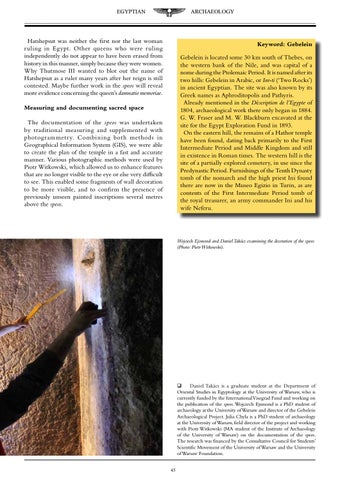
Wojciech Ejsmond and Daniel Takács examining the decoration of the speos (Photo: Piotr Witkowski).
Daniel Takács is a graduate student at the Department of Oriental Studies in Egyptology at the University of Warsaw, who is currently funded by the International Visegrad Fund and working on the publication of the speos. Wojciech Ejsmond is a PhD student of archaeology at the University of Warsaw and director of the Gebelein Archaeological Project. Julia Chyla is a PhD student of archaeology at the University of Warsaw, field director of the project and working with Piotr Witkowski (MA student of the Institute of Archaeology of the University of Warsaw) on the documentation of the speos. The research was financed by the Consultative Council for Students’ Scientific Movement of the University of Warsaw and the University of Warsaw Foundation. 45