EGYPTIAN
ARCHAEOLOGY
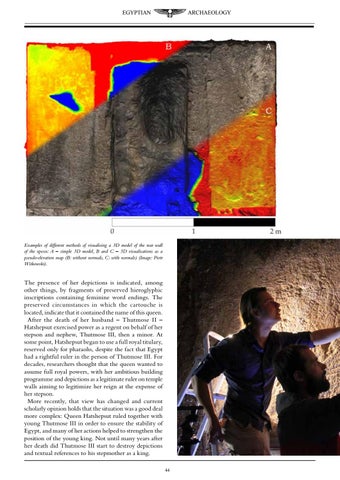
Examples of different methods of visualising a 3D model of the rear wall of the speos: A – simple 3D model, B and C – 3D visualisations as a pseudo-elevation map (B: without normals, C: with normals) (Image: Piotr Witkowski).
The presence of her depictions is indicated, among other things, by fragments of preserved hieroglyphic inscriptions containing feminine word endings. The preserved circumstances in which the cartouche is located, indicate that it contained the name of this queen. After the death of her husband – Thutmose II – Hatshepsut exercised power as a regent on behalf of her stepson and nephew, Thutmose III, then a minor. At some point, Hatshepsut began to use a full royal titulary, reserved only for pharaohs, despite the fact that Egypt had a rightful ruler in the person of Thutmose III. For decades, researchers thought that the queen wanted to assume full royal powers, with her ambitious building programme and depictions as a legitimate ruler on temple walls aiming to legitimize her reign at the expense of her stepson. More recently, that view has changed and current scholarly opinion holds that the situation was a good deal more complex: Queen Hatshepsut ruled together with young Thutmose III in order to ensure the stability of Egypt, and many of her actions helped to strengthen the position of the young king. Not until many years after her death did Thutmose III start to destroy depictions and textual references to his stepmother as a king. 44