EGYPTIAN
ARCHAEOLOGY
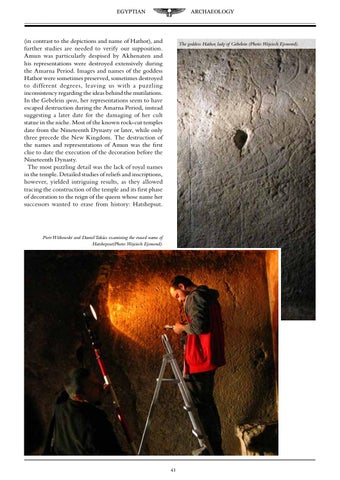
(in contrast to the depictions and name of Hathor), and further studies are needed to verify our supposition. Amun was particularly despised by Akhenaten and his representations were destroyed extensively during the Amarna Period. Images and names of the goddess Hathor were sometimes preserved, sometimes destroyed to different degrees, leaving us with a puzzling inconsistency regarding the ideas behind the mutilations. In the Gebelein speos, her representations seem to have escaped destruction during the Amarna Period, instead suggesting a later date for the damaging of her cult statue in the niche. Most of the known rock-cut temples date from the Nineteenth Dynasty or later, while only three precede the New Kingdom. The destruction of the names and representations of Amun was the first clue to date the execution of the decoration before the Nineteenth Dynasty. The most puzzling detail was the lack of royal names in the temple. Detailed studies of reliefs and inscriptions, however, yielded intriguing results, as they allowed tracing the construction of the temple and its first phase of decoration to the reign of the queen whose name her successors wanted to erase from history: Hatshepsut.
The goddess Hathor, lady of Gebelein (Photo:Wojciech Ejsmond).
Piotr Witkowski and Daniel Takรกcs examining the erased name of Hatshepsut(Photo:Wojciech Ejsmond).
43