EGYPTIAN
ARCHAEOLOGY
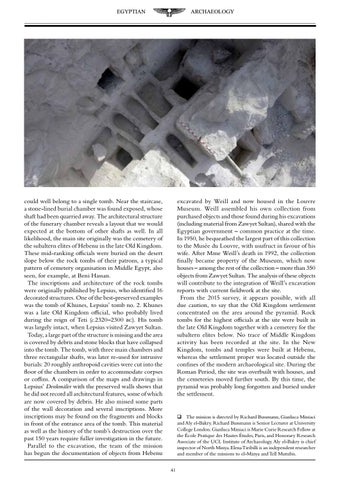
could well belong to a single tomb. Near the staircase, a stone-lined burial chamber was found exposed, whose shaft had been quarried away. The architectural structure of the funerary chamber reveals a layout that we would expected at the bottom of other shafts as well. In all likelihood, the main site originally was the cemetery of the subaltern elites of Hebenu in the late Old Kingdom. These mid-ranking officials were buried on the desert slope below the rock tombs of their patrons, a typical pattern of cemetery organisation in Middle Egypt, also seen, for example, at Beni Hassan. The inscriptions and architecture of the rock tombs were originally published by Lepsius, who identified 16 decorated structures. One of the best-preserved examples was the tomb of Khunes, Lepsius’ tomb no. 2. Khunes was a late Old Kingdom official, who probably lived during the reign of Teti (c.2320–2300 bc). His tomb was largely intact, when Lepsius visited Zawyet Sultan. Today, a large part of the structure is missing and the area is covered by debris and stone blocks that have collapsed into the tomb. The tomb, with three main chambers and three rectangular shafts, was later re-used for intrusive burials: 20 roughly anthropoid cavities were cut into the floor of the chambers in order to accommodate corpses or coffins. A comparison of the maps and drawings in Lepsius’ Denkmäler with the preserved walls shows that he did not record all architectural features, some of which are now covered by debris. He also missed some parts of the wall decoration and several inscriptions. More inscriptions may be found on the fragments and blocks in front of the entrance area of the tomb. This material as well as the history of the tomb’s destruction over the past 150 years require fuller investigation in the future. Parallel to the excavation, the team of the mission has begun the documentation of objects from Hebenu
excavated by Weill and now housed in the Louvre Museum. Weill assembled his own collection from purchased objects and those found during his excavations (including material from Zawyet Sultan), shared with the Egyptian government – common practice at the time. In 1950, he bequeathed the largest part of this collection to the Musée du Louvre, with usufruct in favour of his wife. After Mme Weill’s death in 1992, the collection finally became property of the Museum, which now houses – among the rest of the collection – more than 350 objects from Zawyet Sultan. The analysis of these objects will contribute to the integration of Weill’s excavation reports with current fieldwork at the site. From the 2015 survey, it appears possible, with all due caution, to say that the Old Kingdom settlement concentrated on the area around the pyramid. Rock tombs for the highest officials at the site were built in the late Old Kingdom together with a cemetery for the subaltern elites below. No trace of Middle Kingdom activity has been recorded at the site. In the New Kingdom, tombs and temples were built at Hebenu, whereas the settlement proper was located outside the confines of the modern archaeological site. During the Roman Period, the site was overbuilt with houses, and the cemeteries moved further south. By this time, the pyramid was probably long forgotten and buried under the settlement.
The mission is directed by Richard Bussmann, Gianluca Miniaci and Aly el-Bakry. Richard Bussmann is Senior Lecturer at University College London. Gianluca Miniaci is Marie Curie Research Fellow at the École Pratique des Hautes Études, Paris, and Honorary Research Associate of the UCL Institute of Archaeology. Aly el-Bakry is chief inspector of North Minya. Elena Tiribilli is an independent researcher and member of the missions to el-Minya and Tell Mutubis. 41