EGYPTIAN
ARCHAEOLOGY
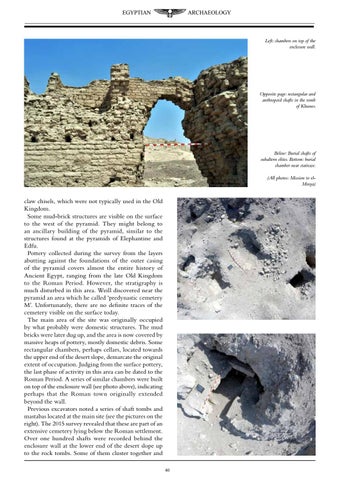
Left: chambers on top of the enclosure wall.
Opposite page: rectangular and anthropoid shafts in the tomb of Khunes.
Below: Burial shafts of subaltern elites. Bottom: burial chamber near staircase. (All photos: Mission to elMinya)
claw chisels, which were not typically used in the Old Kingdom. Some mud-brick structures are visible on the surface to the west of the pyramid. They might belong to an ancillary building of the pyramid, similar to the structures found at the pyramids of Elephantine and Edfu. Pottery collected during the survey from the layers abutting against the foundations of the outer casing of the pyramid covers almost the entire history of Ancient Egypt, ranging from the late Old Kingdom to the Roman Period. However, the stratigraphy is much disturbed in this area. Weill discovered near the pyramid an area which he called ‘predynastic cemetery M’. Unfortunately, there are no definite traces of the cemetery visible on the surface today. The main area of the site was originally occupied by what probably were domestic structures. The mud bricks were later dug up, and the area is now covered by massive heaps of pottery, mostly domestic debris. Some rectangular chambers, perhaps cellars, located towards the upper end of the desert slope, demarcate the original extent of occupation. Judging from the surface pottery, the last phase of activity in this area can be dated to the Roman Period. A series of similar chambers were built on top of the enclosure wall (see photo above), indicating perhaps that the Roman town originally extended beyond the wall. Previous excavators noted a series of shaft tombs and mastabas located at the main site (see the pictures on the right). The 2015 survey revealed that these are part of an extensive cemetery lying below the Roman settlement. Over one hundred shafts were recorded behind the enclosure wall at the lower end of the desert slope up to the rock tombs. Some of them cluster together and 40