EGYPTIAN
ARCHAEOLOGY
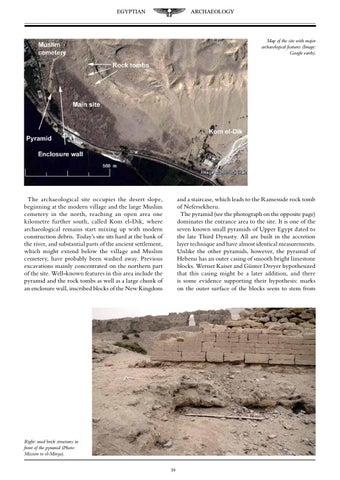
Map of the site with major archaeological features (Image: Google earth).
The archaeological site occupies the desert slope, beginning at the modern village and the large Muslim cemetery in the north, reaching an open area one kilometre further south, called Kom el-Dik, where archaeological remains start mixing up with modern construction debris. Today’s site sits hard at the bank of the river, and substantial parts of the ancient settlement, which might extend below the village and Muslim cemetery, have probably been washed away. Previous excavations mainly concentrated on the northern part of the site. Well-known features in this area include the pyramid and the rock tombs as well as a large chunk of an enclosure wall, inscribed blocks of the New Kingdom
and a staircase, which leads to the Ramesside rock tomb of Nefersekheru. The pyramid (see the photograph on the opposite page) dominates the entrance area to the site. It is one of the seven known small pyramids of Upper Egypt dated to the late Third Dynasty. All are built in the accretion layer technique and have almost identical measurements. Unlike the other pyramids, however, the pyramid of Hebenu has an outer casing of smooth bright limestone blocks. Werner Kaiser and GĂźnter Dreyer hypothesized that this casing might be a later addition, and there is some evidence supporting their hypothesis: marks on the outer surface of the blocks seem to stem from
Right: mud brick structures in front of the pyramid (Photo: Mission to el-Minya). 39