EGYPTIAN
ARCHAEOLOGY
The pyramid, town and cemeteries of Zawyet Sultan The archaeological remains of Hebenu, modern Zawyet Sultan, opposite el-Minya, shed light on the life of a provincial town from prehistory up to the early Islamic Period. Richard Bussmann, Gianluca Miniaci, Aly el-Bakry and Elena Tiribilli present the preliminary results of their 2015 survey at the site. The remains of Hebenu offer an excellent opportunity to explore an ancient Egyptian settlement together with the cemeteries of its inhabitants. The archaeological site lies adjacent to the modern village of Zawyet Sultan, better known in Egyptology as Zawyet el-Maiyitin, Zawyet al-Amwat or Kom el-Ahmar. Hebenu was the capital of the 16th Upper Egyptian nome in pharaonic times and is most famous for its small pyramid and a series of decorated rock tombs of the Old and New Kingdoms. Previous fieldwork at the site, by Richard
Lepsius, Alexandre Varille, Raymond Weill and a team led by Barry Kemp, has brought to light a wealth of objects from the Predynastic Period, the Old and New Kingdoms and the Late Period through the early Islamic Period. However, it is difficult to understand how monuments and objects relate to the settlement remains and the landscape of Hebenu. The aim of the current archaeological mission therefore is to establish a local context for the pyramid and to explore life at Hebenu/ Zawyet Sultan over the past 5,000 years.
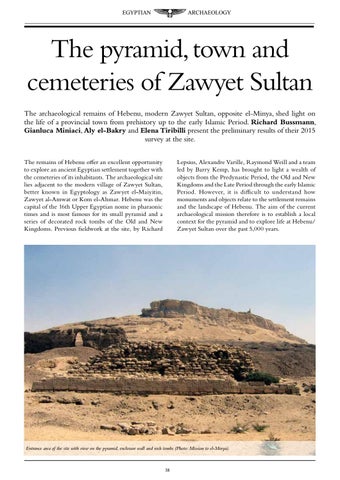
Entrance area of the site with view on the pyramid, enclosure wall and rock tombs (Photo: Mission to el-Minya).
38