EGYPTIAN
ARCHAEOLOGY
Naukratis in its riverine setting Since 2012, the British Museum has been undertaking a programme of survey and excavation at the port of Naukratis in the western Delta. Ben Pennington describes how new geoarchaeological fieldwork (funded by the EES since 2014) aims to paint a picture of the ancient landscape around the important Late Period, Ptolemaic, Roman and Byzantine site. From the late 7th century bc, the city of Naukratis in the western Delta was one of the most important ports in Egypt. It was the place where trade between Late Period Egypt and the Greek Mediterranean was focused and the economic gateway to the royal Pharaonic city of Sais. The city was home to a cosmopolitan population of Greeks, Egyptians, Cypriots and Phoenicians. An enormous temenos to Amun-Ra in the south of the city existed in tandem with Greek temples to Apollo, the Dioscuri (Castor and Pollux, favoured patrons of sailors), Hera, Aphrodite and others in the north. The settlement continued to flourish for over a thousand years, through Ptolemaic Egypt and the Roman period, and into Byzantine times before declining at some point in the later first millennium ce. Naukratis was first excavated by Flinders Petrie from 1884 onwards, and then by David Hogarth and Ernest Gardner at the close of the nineteenth century. Since that time (and a little earlier), the site has constantly been under threat from the actions of the sebbakhin:
local farmers who dug out the mud-brick walls of the buildings for use as fertilizer on their fields. This quarrying of the site continued through the early twentieth century such that by the time the next set of archaeologists arrived in the 1970s and 1980s, the area of previous excavations was by then an enormous manmade lake some 3 or 4 m deep, the size of nearly seven football fields. More recently, the lake has been mostly drained by the Egyptian authorities, a new fieldwork programme has been initiated by the British Museum (since 2012), and access to the site of the original excavations is now possible again, if a little damp and boggy in places! Surrounding the old lake depression are various villages collectively known as Kom Geif (Kom Jiayf ), home to many of our local workmen and hospitable villagers, many of whom are very interested in the work we are doing. The British Museum Naukratis Project, directed by Dr Alexandra Villing, has been working for over a decade on artefacts that were collected during the early
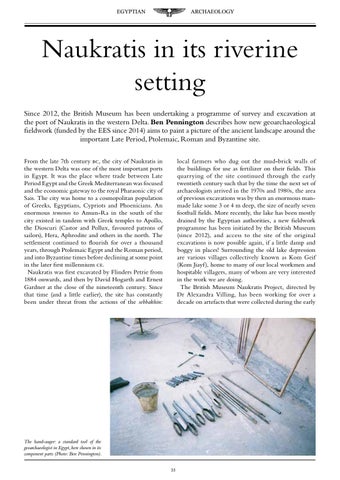
The hand-auger: a standard tool of the geoarchaeologist in Egypt, here shown in its component parts (Photo: Ben Pennington). 35