EGYPTIAN
ARCHAEOLOGY
Egypt Exploration Society Expeditions (www.ees.ac.uk)
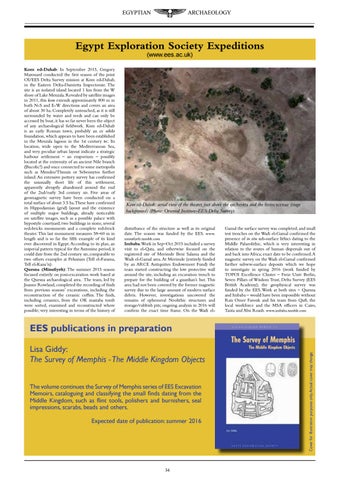
Kom ed-Dahab: In September 2015, Gregory Marouard conducted the first season of the joint OI/EES Delta Survey mission at Kom ed-Dahab, in the Eastern Delta-Damietta Inspectorate. The site is an isolated island located 1 km from the W shore of Lake Menzala. Revealed by satellite images in 2011, this kom extends approximately 800 m in both N-S and E-W directions and covers an area of about 30 ha. Completely untouched, as it is still surrounded by water and reeds and can only be accessed by boat, it has so far never been the object of any archaeological fieldwork. Kom ed-Dahab is an early Roman town, probably an ex nihilo foundation, which appears to have been established in the Menzala lagoon in the 1st century bc. Its location, wide open to the Mediterranean Sea, and very peculiar urban layout indicate a strategic harbour settlement – an emporium – possibly located at the extremity of an ancient Nile branch (Bucolic?) and once connected to some metropolis such as Mendes/Thmuis or Sebennytos further inland. An extensive pottery survey has confirmed the unusually short life of this settlement, apparently abruptly abandoned around the end of the 2nd/early 3rd century ad. Five areas of geomagnetic survey have been conducted on a total surface of about 3.5 ha.These have confirmed its Hippodamian (grid) layout and the existence of multiple major buildings, already noticeable on satellite images, such as a possible palace with hypostyle courtyard, two buildings in stone, several red-bricks monuments and a complete red-brick theater. This last monument measures 58–60 m in length and is so far the fifth example of its kind ever discovered in Egypt. According to its plan, an imperial pattern typical for the Antonine period, it could date from the 2nd century ad, comparable to two others examples at Pelusium (Tell el-Farama, Tell el-Kana’is). Quesna (Minufiyeh): The summer 2015 season focused entirely on post-excavation work based at the Quesna archaeological area. The team, led by Joanne Rowland, completed the recording of finds from previous seasons’ excavations, including the reconstruction of the ceramic coffins. The finds, including ceramics, from the OK mastaba tomb were sorted, examined and reconstructed where possible; very interesting in terms of the history of
Kom ed-Dahab: aerial view of the theater, just above the orchestra and the frons scenae (stage background) (Photo: Oriental Institute-EES Delta Survey). disturbance of the structure as well as its original date. The season was funded by the EES. www. minufiyeh.tumblr.com
Imbaba:Work in Sep–Oct 2015 included a survey visit to el-Qata, and otherwise focused on the registered site of Merimde Beni Salama and the Wadi el-Gamal area. At Merimde (entirely funded by an ARCE Antiquities Endowment Fund) the team started constructing the low protective wall around the site, including an excavation trench to prepare for the building of a guardian’s hut. This area had not been covered by the former magnetic survey due to the large amount of modern surface debris. However, investigations uncovered the remains of ephemeral Neolithic structures and storage/rubbish pits; ongoing analysis in 2016 will confirm the exact time frame. On the Wadi el-
Gamal the surface survey was completed, and small test trenches on the Wadi el-Gamal confirmed the presence of in situ sub-surface lithics dating to the Middle Palaeolithic, which is very interesting in relation to the routes of human dispersals out of and back into Africa; exact date to be confirmed. A magnetic survey on the Wadi el-Gamal confirmed further subww-surface deposits which we hope to investigate in spring 2016 (work funded by TOPOI Excellence Cluster – Freie Univ Berlin, Seven Pillars of Wisdom Trust, Delta Survey (EES British Academy); the geophysical survey was funded by the EES. Work at both sites – Quesna and Imbaba – would have been impossible without Rais Omer Farouk and his team from Quft, the local workforce and the MSA officers in Cairo, Tanta and Abu Roash. www.imbaba.tumblr.com
Lisa Giddy: The Survey of Memphis - The Middle Kingdom Objects The volume continues the Survey of Memphis series of EES Excavation Memoirs, cataloguing and classifying the small finds dating from the Middle Kingdom, such as flint tools, polishers and burnishers, seal impressions, scarabs, beads and others. Expected date of publication: summer 2016
34
Cover for illustration purposes only. Actual cover may change.
EES publications in preparation