EGYPTIAN
ARCHAEOLOGY
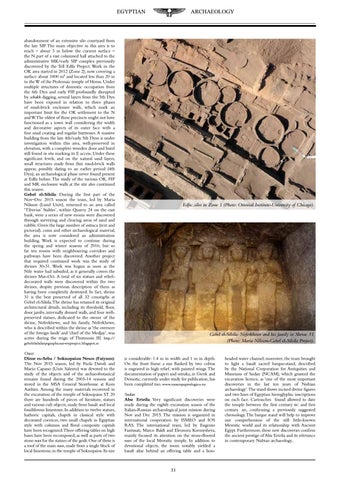
abandonment of an extensive silo courtyard from the late SIP. The main objective in this area is to reach – about 3 m below the current surface – the N part of a vast columned hall attached to the administrative MK/early SIP complex previously discovered by the Tell Edfu Project. Work in the OK area started in 2012 (Zone 2), now covering a surface about 1000 m2 and located less than 20 m to the W of the Ptolemaic temple of Horus. Under multiple structures of domestic occupation from the 6th Dyn and early FIP, profoundly disrupted by sebakh digging, several layers from the 5th Dyn have been exposed in relation to three phases of mud-brick enclosure walls, which mark an important limit for the OK settlement to the N and W.The oldest of these precincts might not have functioned as a town wall considering the width and decorative aspects of its outer face with a fine mud coating and regular buttresses. A massive building from the late 4th/early 5th Dyns is under investigation within this area, well-preserved in elevation, with a complete wooden door and lintel still found in situ marking its E access. Under these significant levels, and on the natural sand layers, small structures made from thin mud-brick walls appear, possibly dating to an earlier period (4th Dyn), an archaeological phase never found present at Edfu before. The study of the various OK, FIP and MK enclosure walls at the site also continued this season. Gebel el-Silsila: During the first part of the Nov–Dec 2015 season the team, led by Maria Nilsson (Lund Univ), returned to an area called ‘Tiberius’ Stables’, within Quarry 24 on the east bank, were a series of new rooms were discovered through surveying and clearing areas of sand and rubble. Given the large number of ostraca (text and pictorial), coins and other archaeological material, the area is now considered an administration building. Work is expected to continue during the spring and winter seasons of 2016, but so far ten rooms with neighbouring corridors and pathways have been discovered. Another project that required continued work was the study of shrines 30-31. Work was begun as soon as the Nile water had subsided, as it generally covers the shrines Mar-Oct. A total of six statues and reliefdecorated walls were discovered within the two shrines, despite previous description of them as having been completely destroyed. In fact, shrine 31 is the best preserved of all 32 cenotaphs at Gebel el-Silsila. The shrine has retained its original architectural details, including its threshold, floor, door jambs, internally dressed walls, and four wellpreserved statues, dedicated to the owner of the shrine, Neferkhewe, and his family. Neferkhewe, who is described within the shrine as ‘the overseer of the foreign lands’ and ‘chief of the Medjay’, was active during the reign of Thutmosis III. http://
Edfu: silos in Zone 1 (Photo: Oriental Institute-University of Chicago).
Gebel el-Silsila: Neferkhewe and his family in Shrine 31 (Photo: Maria Nilsson-Gebel el-Silsila Project).
gebelelsilsilaepigraphicsurveyproject.blogspot.se
Oases Dime es-Seba / Soknopaiou Nesos (Faiyum): The Nov 2015 season, led by Paola Davoli and Mario Capasso (Univ Salento) was devoted to the study of the objects and of the archaeobotanical remains found during the 2003-14 seasons and stored in the MSA General Storehouse at Kom Aushim. Among the many materials recovered in the excavation of the temple of Soknopaios ST 20 there are hundreds of pieces of furniture, statues and various cult objects, made from basalt and local fossiliferous limestone. In addition to twelve statues, hathoric capitals, chapels in classical style with decorated cornices, two small chapels in Egyptian style with columns and floral composite capitals have been recognized.Three offering tables on high bases have been recomposed, as well as parts of two stone naoi for the statues of the gods. One of these is a roof of the main naos, made from a single block of local limestone, in the temple of Soknopaios. Its size
is considerable: 1.4 m in width and 1 m in depth. On the front frame a sun flanked by two cobras is engraved in high relief, with painted wings. The documentation of papyri and ostraka, in Greek and Demotic, currently under study for publication, has been completed too. www.museopapirologico.eu Sudan Abu Erteila: Very significant discoveries were made during the eighth excavation season of the Italian-Russian archaeological joint mission during Nov and Dec 2015. The mission is organized in international cooperation by ISMEO and IOS RAS. The international team, led by Eugenio Fantusati, Marco Baldi and Eleonora Kormysheva, mainly focused its attention on the stone-floored naos of the local Meroitic temple. In addition to devotional objects, the room notably yielded a basalt altar behind an offering table and a lion-
33
headed water channel; moreover, the team brought to light a basalt sacred barque-stand, described by the National Corporation for Antiquities and Museums of Sudan (NCAM), which granted the excavation licence, as ‘one of the most important discoveries in the last ten years of Nubian archaeology’.The stand shows incised divine figures and two lines of Egyptian hieroglyphic inscriptions on each face. Cartouches found allowed to date the temple between the first century bc and first century ad, confirming a previously suggested chronology. The barque stand will help to improve our comprehension of the still little-known Meroitic world and its relationship with Ancient Egypt. Furthermore, these new discoveries confirm the ancient prestige of Abu Erteila and its relevance in contemporary Nubian archaeology..