EGYPTIAN
ARCHAEOLOGY
Medinet Habu: the Western High Gate team – Yarko Kobylecky, Hilary McDonald, Ellie Smith, Owen Murray, Brett McClain, Jen Kimpton, Anait Helmholz, and Keli Alberts (Photo: Ray Johnson). of the Underworld around the cenotaph (XIII), Daniel Werning (Humboldt Univ Berlin) and Barbara Engelmann von Carnap (Heidelberg Univ) worked respectively on the Book of Caverns (rooms XVII-XIX) and the Opening of the Mouth ritual (room V). One of the goals of the season was also to scan the cenotaph, in order to have precise plan and sections of this monumental area, but due to external factors beyond our control, use of the 3D scan proved impossible. We could nevertheless create a topographic relief of the cenotaph thanks to the combined use of photogrammetry and topography (Olivier Onézime and Gaël Pollin, IFAO). The images are georeferenced. While there are no final results yet, the preliminary plan/sections already reveal amazing insights. We will pursue the use of photogrammetry and topography in the rest of the tomb in the next seasons. http://www.ifao. egnet.net/archeologie/tt33/ ••• http://egypte.unistra. fr/les-travaux-de-terrain/la-tombe-de-padiamenopett33-responsable-claude-traunecker/ ••• http://www. montpellier-egyptologie.fr/tombe33?PHPSESSID=cabe b469070117fe40ad4582572fcf46
Western Thebes (TT 47): The ninth season of work at el-Khokha by a team from Waseda University under the direction of Jiro Kondo took place between Dec 2015 and Jan 2016. The main objective was to clean the forecourt of the tomb of Userhat, Overseer of the King’s Private Apartment under Amenhotep III, which had been rediscovered in 2007. In the course of clearance, a dense concentration of the pottery sherds dating to the Ptolemaic Period was revealed. In addition, a number of the fragments of funerary equipment such as a coffin, canopic chest, and shabtis (Late to Ptolemaic Period) recovered in the forecourt. A complete Demotic ostracon was found as well. A condition survey and initial conservation intervention for the wall paintings were carried out in the tomb of Khonsuemheb, discovered in 2013. X-ray fluorescence analysis on the pigments of the wall paintings was conducted by a team from Tokyo Univ of Science. An anthropological study of the human remains was done by the scientists from the National Museum of Science in Japan. http://www.egyptpro.sci.waseda.ac.jp/e-tt.html
Western Thebes (TT 107): Initial phases of cleaning in the inscribed portico of TT 107 was supervised by Boyo Ockinga and Susanne Binder from 17–21 Jan 2016 for the Epigraphic Survey. Bases of three rock-cut columns were exposed,
as well as a lower level of limestone rubble fused into a concrete-like conglomerate by ancient floodwaters over the original rock-cut floor. Debris on the floor in front of the tomb doorway was partly removed, revealing a low door sill that supported the mostly destroyed jambs. Two inscribed wall fragments were recovered, a small one from the doorway, and a larger flickstein from the rubble covering the floor area to the E. The rest of the flooring will be cleared next season. Senior epigrapher J. Brett McClain continued the first collation of the facsimile drawings of the portico façade reliefs done by senior epigraphic artists Margaret De Jong and Sue Osgood, while Ray Johnson initiated the second collation of the drawings. http://oi.uchicago.edu/research/projects/epi Armant: The joint IFAO/CNRS-Univ. Montpellier 3/USR 3172 mission, directed by Christophe Thiers (CNRS, USR 3172-CFEETK), continued the archaeological survey in Armant between Oct and Nov 2015, focusing on the area of the naos of the Montu temple. Most of the debris lying above the W part of the naos was removed this season, allowing to uncover parts of the stone foundation. As expected, MK limestone blocks have been reused inside the Ptolemaic foundation; they are mostly in sunken relief (probably from Amenemhat I), one in high relief. Also one limestone block bears the name of Ramesses II. A granite block with the names of Senwesret III was found; it could match with another one already known on the site. In the E part of the naos, the cleaning of the foundations brought to light another Ramesside block, with figures of Ptah and Sekhmet. At the W edge of the pronaos, a huge wall (probably a precinct wall) cut by the foundation pit was already known; removal of debris revealed another part of this wall running to the N, beneath the debris. It was built directly upon OK levels. The part of the OK section now cleaned shows mud-brick structures, ash and charcoals levels, destruction levels (with broken mud bricks) and a lot of pot sherds. A drainage system built in the middle on this huge mud-brick wall was also uncovered in a sounding on the N. On top of the wall, a round-shaped red brick structure dating to the Byzantine Period was found. Romain David (Univ Montpellier 3) continued studying Ptolemaic and late Roman pottery found during excavations. Pierre Zignani (CNRS UMR 5060) with the help of Mohamed Gaber (topographer,
32
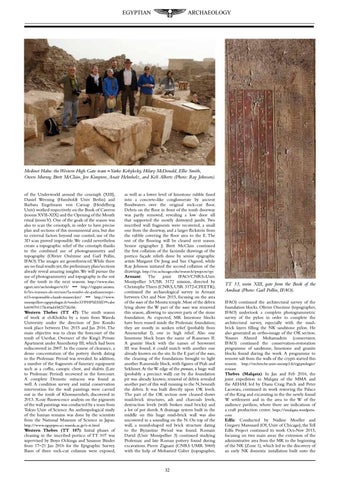
TT 33, room XIII, gate from the Book of the Amduat (Photo: Gaël Pollin, IFAO). IFAO) continued the architectural survey of the foundation blocks. Olivier Onezime (topographer, IFAO) undertook a complete photogrammetric survey of the pylon in order to complete the architectural survey, especially with the mudbrick layers filling the NK sandstone pylon. He also generated an ortho-image of the OK section. Younes Ahmed Mohamadein (conservator, IFAO) continued the conservation-restoration programme of sandstone, limestone and granite blocks found during the work. A programme to remove salt from the walls of the crypts started this season. http://recherche.univ-montp3.fr/egyptologie/ ermant
Thebes (Malqata): In Jan and Feb 2016, the joint expedition to Malqata of the MMA and the AEHAF, led by Diana Craig Patch and Peter Lacovara, continued its work restoring the Palace of the King and excavating in the the newly found W settlement and in the area to the W of the audience pavilion, where there are indications of a craft production center. https://imalqata.wordpress. com
Edfu: Conducted by Nadine Moeller and Gregory Marouard (OI, Univ of Chicago), the Tell Edfu Project continued its work Oct-Nov 2015, focusing on two main areas: the extension of the administrative area from the MK to the beginning of the NK (Zone 1), which led to the discovery of an early NK domestic installation built onto the