EGYPTIAN
ARCHAEOLOGY
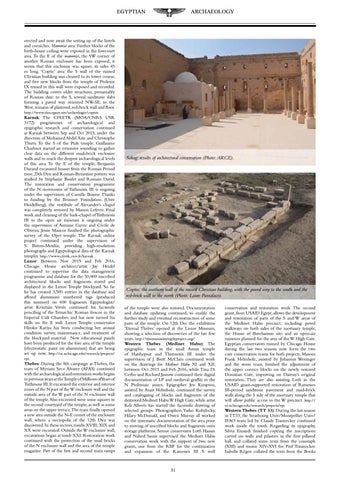
erected and now await the setting up of the lintels and corniches. Mammisi area: Further blocks of the birth-house ceiling were exposed in the forecourt area. To the E of the mammisi, the SW corner of another Roman enclosure has been exposed; it seems that this enclosure was square, its sides 45 m long. ‘Coptic’ area: the S wall of the ruined Christian building was cleaned to its lower course, and five new blocks from the temple of Ptolemy IX reused in this wall were exposed and recorded. The building covers older structures, presumably of Roman date: to the S, several sandstone slabs forming a paved way oriented NW-SE; to the West, remains of plastered, red-brick wall and floor. http://www.ifao.egnet.net/archeologie/coptos
Karnak: The CFEETK (MOA/CNRS USR 3172) programmes of archaeological and epigraphic research and conservation continued at Karnak between Sep and Oct 2015, under the direction of Mohamed Abdel Aziz and Christophe Thiers. To the S of the Ptah temple, Guillaume Charloux started an extensive sounding to gather clear data on the different mud-brick enclosure walls and to reach the deepest archaeological levels of this area. To the E of the temple, Benjamin Durand excavated houses from the Roman Period time; 25th Dyn and Roman-Byzantine pottery was studied by Stéphanie Boulet and Romain David. The restoration and conservation programme of the N storerooms of Tuthmosis III is ongoing under the supervision of Camille Bourse. Thanks to funding by the Brunner Foundation (Univ Heidelberg), the vestibule of Alexander’s chapel was completely restored by Manon Lefevre. Final work and cleaning of the bark-chapel of Tuthmosis III in the open air museum is ongoing under the supervision of Antoine Garric and Cécile de Oliveira. Jessie Maucor finished the photographic survey of the Opet temple. The Karnak online project continued under the supervision of S. Biston-Moulin, providing high-resolution photographs and Egyptological data of the Karnak temples. http://www.cfeetk.cnrs.fr/karnak. Luxor: Between Nov 2015 and Feb 2016, Chicago House architect/artist Jay Heidel continued to supervise the data management programme and database for the 50,000 inscribed architectural blocks and fragments stored and displayed in the Luxor Temple blockyard. So far he has created 3,500 entries in the database and affixed aluminium numbered tags (produced this summer) on 600 fragments. Egyptologist/ artist Krisztián Vertés continued his facsimile penciling of the Tetrarchic Roman frescos in the Imperial Cult Chamber, and has now turned his skills on the E wall. Luxor Temple conservator Hiroko Kariya has been conducting her annual condition survey, maintenance, and treatment of the blockyard material. New educational panels have been produced for the fore area of the temple (electrostatic paint on aluminium) that are being set up now. http://oi.uchicago.edu/research/projects/ epi
Thebes: During the 8th campaign at Thebes, the team of Myriam Seco Álvarez (AFAS) continued with the archaeological and restoration works begun in previous years at the Temple of Millions ofYears of Tuthmose III. It excavated the exterior and interior zones of the N part of the W enclosure wall and the outside area of the W part of the N enclosure wall of the temple. Also excavated were some squares in the second courtyard of the temple, as well as some areas on the upper terrace.The team finally opened a new area outside the N-E corner of the enclosure wall, where a necropolis of the 12th Dyn was discovered. In these sectors, tombs XVIII, XIX and XX were excavated. Outside the W enclosure wall, excavations began at tomb XXI. Restoration work continued with the protection of the mud bricks of the N enclosure wall and the area of the temple magazine. Part of the first and second main ramps
Sohag: results of architectural conservation (Photo: ARCE).
Coptos: the southern wall of the ruined Christian building, with the paved way to the south and the red-brick wall to the north (Photo: Laure Pantalacci). of the temple were also restored. Documentation and database updating continued, to enable the further study and eventual reconstruction of some parts of the temple. On 12th Dec the exhibition ‘Eternal Thebes’ opened at the Luxor Museum, showing a selection of discoveries of the last few years. http://thutmosisiiitempleproject.org/ Western Thebes (Medinet Habu): The epigraphic team in the small Amun temple of Hatshepsut and Thutmosis III under the supervision of J. Brett McClain continued work on the drawings for Medinet Habu XI and XII, between Oct 2015 and Feb 2016, while Tina Di Cerbo and Richard Jasnow continued their digital documentation of LP and medieval graffiti in the N Ptolemaic annex. Epigrapher Jen Kimpton, assisted by Anait Helmholz, continued the survey and cataloguing of blocks and fragments of the destroyed Medinet Habu W High Gate, while artist Keli Alberts has started the facsimile drawing of selected groups. Photographers Yarko Kobylecky, Hilary McDonald, and Owen Murray all worked on the systematic documentation of the area prior to moving of inscribed blocks and fragments onto storage platforms. Senior conservator Lotfi Hassan and Nahed Samir supervised the Medinet Habu conservation work with the support of two new grants, one from the RBF for the continuation and expansion of the Ramesses III S well
31
conservation and restoration work. The second grant, from USAID Egypt, allows the development and restoration of parts of the S and W areas of the Medinet Habu precinct, including paved walkways on both sides of the mortuary temple, the House of Butehamun site, and an open-air museum planned for the area of the W High Gate. Egyptian conservators trained by Chicago House during the last two seasons now form the two core conservation teams for both projects. Masons Frank Helmholz, assisted by Johannes Weninger and the stone team, finished the adjustment of the upper cornice blocks on the newly restored Domitian Gate, improving on Daressy’s original restoration. They are also assisting Lotfi in the USAID grant-supported restoration of Ramesses III-period sandstone pavement and mud-brick walls along the S side of the mortuary temple that will allow public access to the W precinct. http:// oi.uchicago.edu/research/projects/epi
Western Thebes (TT 33): During the last season in TT33, the Strasbourg Univ/Montpellier Univ/ IFAO team led by Claude Traunecker continued work inside the tomb. Regarding its epigraphy, Silvia Einaudi finished copying the inscriptions carved on walls and pilasters in the first pillared hall, and collated some texts from the cenotaph (XIII) and rooms XIV-XVI for Prof Traunecker. Isabelle Régen collated the texts from the Books