EGYPTIAN
ARCHAEOLOGY
Digging Diary 2015-16 Summaries of some of the archaeological work undertaken in Egypt between autumn 2015 and spring 2016. The sites are arranged geographically from north to south, ending with the oases. Field Directors who would like reports of their work to appear in EA are asked to e-mail a short summary, with a website address if available, as soon as possible after the end of each season to: jan.geisbusch@ees.ac.uk
Jan Geisbusch
Abbreviations: EDP Early Dynastic Period; OK Old Kingdom; FIP First Intermediate Period; MK Middle Kingdom; SIP Second Intermediate Period; NK New Kingdom; TIP Third Intermediate Period; LP Late Period; GR Graeco-Roman; ERT Electrical Resistance Tomography; GPR Ground Penetrating Radar Institutes and Research Centres: AEHAF Ancient Egyptian Heritage and Archaeology Fund; AFAS Academy of Fine Arts Seville; ARCE American Research Center in Egypt; CFEETK FrancoEgyptian Centre, Karnak; CNRS (USR) French National Research Centre (Research Groups); DAI German Archaeological Institute, Cairo; IFAO French Archaeological Institute, Cairo; IOS RAS Institute of Oriental Studies of the Russian Academy of the Sciences; ISMEO International Association of Mediterranean and Oriental Studies; MMA Metropolitan Museum of Art; MSA Ministry of State for Antiquities, Egypt; OI Oriental Institute, University of Chicago; RBF Rockefeller Brothers Fund. Lower Egypt Buto: The survey of the DAI Cairo led by Robert Schiestl continued in autumn 2015 with a study of the landscape in the region about 5 km NE of Buto (Tell el-Farain). Following the detection of an ancient Nile branch by auger core drilling in 2014, about 2 km E of Kom elGir and about 500 m E of the modern Masraf Bahr Nashart, the investigation with a vibracoring device was continued in cooperation with Andreas Ginau of the Dpt of Geography of the Goethe Univ Frankfurt am Main. Two transects across the supposed course of the branch were laid N and S of the 2014 transect. While evidence of an incised ancient watercourse appeared in the S transect, this was not the case in the N transect, suggesting a different course. https://www.dainst.org/projekt/-/ project-display/51318
Northwest Saqqara/Abusir South: During Sep 2015, a Japanese mission from Waseda University under the direction of Sakuji Yoshimura and Nozomu Kawai conducted supplementary
excavations in the monument of Prince Khaemwaset and the tomb chapel of Isisnofret on the summit of a limestone outcrop, approximately 1.5 km NW of the Serapeum. They found several relief fragments from the walls and the false door in the monument of Khaemwaset.The area around the shaft of the tomb of Isisnofret was excavated in order to understand the stratigraphy from the initial excavation of the tomb till the disturbance by ancient tomb robbers. Several fragments of potsherds originating from the burial chamber were uncovered in the debris left by later intruders to the burial chamber. They also continued restoration work of the sarcophagus of Isisnofret, led by Hiroko Kariya. http://www.egyptpro.sci. waseda.ac.jp/e-abusir.html
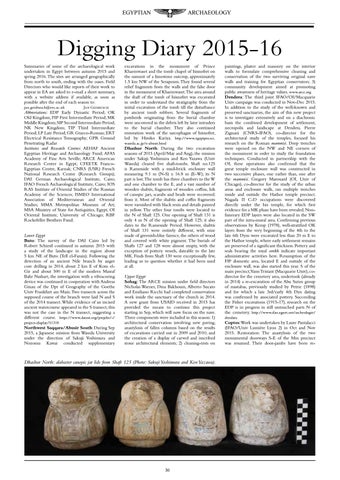
Dhashur North: During the two excavation seasons of 2015 (April/May and Aug), the mission under Sakuji Yoshimura and Ken Yazawa (Univ Waseda) cleared five shaft-tombs. Shaft no.125 is Ramesside with a mud-brick enclosure wall measuring 9.1 m (N-S) x 16.8 m (E-W); its N part is lost. The tomb has three chambers to the W and one chamber to the E, and a vast number of wooden shabtis, fragments of wooden coffins, lids of canopic jars, scarabs and beads were recovered. from it. Most of the shabtis and coffin fragments were varnished with black resin and details painted in yellow. The other four tombs were located to the N of Shaft 125. One opening of Shaft 131 is only 4 m N of the opening of Shaft 125; it also dates to the Ramesside Period. However, shabtis of Shaft 131 were entirely different, with nine made of greenish-blue faience, the others of wood and covered with white pigment. The burials of Shafts 127 and 128 were almost empty, with the exception of pottery vessels, dateable to the late MK. Finds from Shaft 130 were exceptionally few, leading us to question whether it had been used at all. Upper Egypt Sohag: The ARCE mission under field directors Nicholas Warner, Dina Bakhoum, Alberto Sucato and Emiliano Ricchi had completed conservation work inside the sanctuary of the church in 2014. A new grant from USAID received in 2015 has provided the means to continue this project starting in Sep, which will now focus on the nave. Three components were included in this season: 1) architectural conservation involving new paving, anastylosis of fallen columns based on the results of excavations carried out in 2009 and 2010, and the creation of a display of carved and inscribed stone architectural elements; 2) cleaning-tests on
Dhashur North: alabaster canopic jar lids from Shaft 125 (Photo: Sakuji Yoshimura and Ken Yazawa).
30
paintings, plaster and masonry on the interior walls to formulate comprehensive cleaning and conservation of the two surviving original nave walls and training for Egyptian conservators; 3) community development aimed at promoting public awareness of heritage values. www.arce.org Dendera: The third joint IFAO/OI/Macquarie Univ campaign was conducted in Nov-Dec 2015. In addition to the study of the well-known and preserved sanctuaries, the aim of this new project is to investigate extensively and on a diachronic basis the combined development of settlement, necropolis and landscape at Dendera. Pierre Zignani (CNRS-IFAO), co-director for the architectural study of the temples, focused his research on the Roman mammisi. Deep trenches were opened on the NW and NE corners of the monument in order to study the foundation techniques. Conducted in partnership with the OI, these operations also confirmed that the great temple enclosure wall was constructed in two successive phases, one earlier than, one after the mammisi. Gregory Marouard (OI, Univ of Chicago), co-director for the study of the urban areas and enclosure walls, ran multiple trenches inside and outside the Hathor temple precinct. Nagada II C-D occupations were discovered directly under the Isis temple, for which first evidence for a MK phase have been revealed. Nonfunerary EDP layers were also located in the SW part of the intra-mural area. Confirming previous observations by Kemp (1978), well-stratified OK layers from the very beginning of the 4th to the late 6th Dyns were excavated less than 20 m E to the Hathor temple, where early settlement remains are preserved of a significant thickness. Pottery and seals bearing the royal serekh indicate important administrative activities here. Resumption of the FIP domestic area, located E and outside of the enclosure wall, was also started this year. S of the main precinct,Yann Tristant (Macquarie Univ), codirector for the cemetery area, undertook (already in 2014) a re-excavation of the Abu Suten group of mastabas, previously studied by Petrie (1898) and for which a late 3rd/early 4th Dyn dating was confirmed by associated pottery. Succeeding the Fisher excavations (1915-17), research on the EDP is in progress in still untouched parts N of the cemetery. http://www.ifao.egnet.net/archeologie/ dendara
Coptos:Work was undertaken by Laure Pantalacci (IFAO/Univ Lumière Lyon 2) in Oct and Nov 2015. Restoration: The anastylosis of the two monumental doorways S-E of the Min precinct was resumed. Their door-jambs have been re-