EGYPTIAN
ARCHAEOLOGY
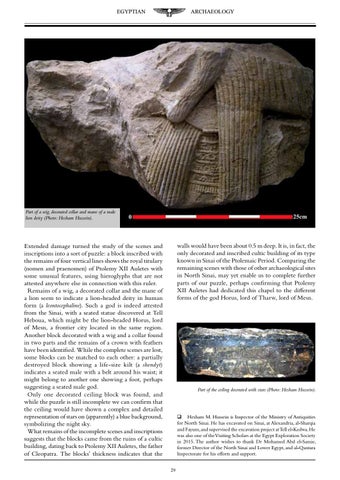
Part of a wig, decorated collar and mane of a male lion deity (Photo: Hesham Hussein).
walls would have been about 0.5 m deep. It is, in fact, the only decorated and inscribed cultic building of its type known in Sinai of the Ptolemaic Period. Comparing the remaining scenes with those of other archaeological sites in North Sinai, may yet enable us to complete further parts of our puzzle, perhaps confirming that Ptolemy XII Auletes had dedicated this chapel to the different forms of the god Horus, lord of Tharw, lord of Mesn.
Extended damage turned the study of the scenes and inscriptions into a sort of puzzle: a block inscribed with the remains of four vertical lines shows the royal titulary (nomen and praenomen) of Ptolemy XII Auletes with some unusual features, using hieroglyphs that are not attested anywhere else in connection with this ruler. Remains of a wig, a decorated collar and the mane of a lion seem to indicate a lion-headed deity in human form (a leontocephaline). Such a god is indeed attested from the Sinai, with a seated statue discovered at Tell Heboua, which might be the lion-headed Horus, lord of Mesn, a frontier city located in the same region. Another block decorated with a wig and a collar found in two parts and the remains of a crown with feathers have been identified. While the complete scenes are lost, some blocks can be matched to each other: a partially destroyed block showing a life-size kilt (a shendyt) indicates a seated male with a belt around his waist; it might belong to another one showing a foot, perhaps suggesting a seated male god. Only one decorated ceiling block was found, and while the puzzle is still incomplete we can confirm that the ceiling would have shown a complex and detailed representation of stars on (apparently) a blue background, symbolizing the night sky. What remains of the incomplete scenes and inscriptions suggests that the blocks came from the ruins of a cultic building, dating back to Ptolemy XII Auletes, the father of Cleopatra. The blocks’ thickness indicates that the
Part of the ceiling decorated with stars (Photo: Hesham Hussein).
ď ą Hesham M. Hussein is Inspector of the Ministry of Antiquities for North Sinai. He has excavated on Sinai, at Alexandria, al-Sharqia and Fayum, and supervised the excavation project at Tell el-Kedwa. He was also one of the Visiting Scholars at the Egypt Exploration Society in 2015. The author wishes to thank Dr Mohamed Abd el-Samie, former Director of the North Sinai and Lower Egypt, and al-Qantara Inspectorate for his efforts and support. 29