EGYPTIAN
ARCHAEOLOGY
Searching for Ptolemy XII: inscriptions from Sinai Hesham Hussein gives us a look at some finds from Tell Maessalem, near Port Said: well-preserved blocks of an as yet unidentified cult building of Ptolemy XII Auletes (c.80–58 and 55–51 bc) for the first time reveal historical traces of that king in this north-western region of the Sinai Peninsula.
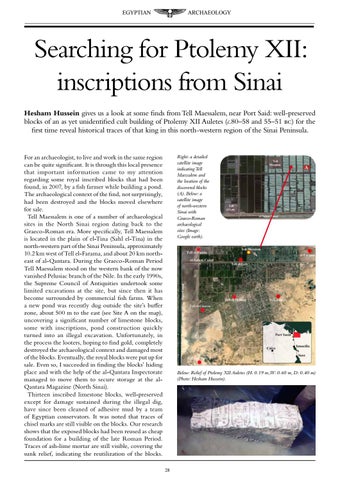
Right: a detailed satellite image indicating Tell Maessalem and the location of the discovered blocks (A). Below: a satellite image of north-western Sinai with Graeco-Roman archaeological sites (Image: Google earth).
For an archaeologist, to live and work in the same region can be quite significant. It is through this local presence that important information came to my attention regarding some royal inscribed blocks that had been found, in 2007, by a fish farmer while building a pond. The archaeological context of the find, not surprisingly, had been destroyed and the blocks moved elsewhere for sale. Tell Maessalem is one of a number of archaeological sites in the North Sinai region dating back to the Graeco-Roman era. More specifically, Tell Maessalem is located in the plain of el-Tina (Sahl el-Tina) in the north-western part of the Sinai Peninsula, approximately 10.2 km west of Tell el-Farama, and about 20 km northeast of al-Qantara. During the Graeco-Roman Period Tell Maessalem stood on the western bank of the now vanished Pelusiac branch of the Nile. In the early 1990s, the Supreme Council of Antiquities undertook some limited excavations at the site, but since then it has become surrounded by commercial fish farms. When a new pond was recently dug outside the site’s buffer zone, about 500 m to the east (see Site A on the map), uncovering a significant number of limestone blocks, some with inscriptions, pond construction quickly turned into an illegal excavation. Unfortunately, in the process the looters, hoping to find gold, completely destroyed the archaeological context and damaged most of the blocks. Eventually, the royal blocks were put up for sale. Even so, I succeeded in finding the blocks’ hiding place and with the help of the al-Qantara Inspectorate managed to move them to secure storage at the alQantara Magazine (North Sinai). Thirteen inscribed limestone blocks, well-preserved except for damage sustained during the illegal dig, have since been cleaned of adhesive mud by a team of Egyptian conservators. It was noted that traces of chisel marks are still visible on the blocks. Our research shows that the exposed blocks had been reused as cheap foundation for a building of the late Roman Period. Traces of ash-lime mortar are still visible, covering the sunk relief, indicating the reutilization of the blocks.
Below: Relief of Ptolemy XII Auletes (H: 0.19 m,W: 0.60 m, D: 0.40 m) (Photo: Hesham Hussein).
28