EGYPTIAN
ARCHAEOLOGY
glass ingots from the Uluburun shipwreck have shown that these were similar in composition to the dark blue glass from New Kingdom Egypt. It has been suggested that the cobalt was sourced in the Egyptian Western Desert, in the region of the Dakhla and Kharga oases, indicating that the glass is of Egyptian origin. This is based on the presence of nickel, zinc and manganese, which occur together with aluminium in impurities of Egyptian cobalt sources. Simultaneously, Egyptian cobalt glasses have been found to contain higher levels of alumina than those coloured with copper. Therefore, a representative scatterplot was produced, based on similar plots produced on museum objects previously analysed. This plot shows some overlap in the two groups, but also highlights distinctive concentrations. It would now be possible to recreate this with the two recently discovered glass ingots in addition to other glass objects from Amarna. The experiments have demonstrated that pXRF technology can measure to a suff icient degree of reliability chemical elements which can help indicate the origins of the glasses and their raw materials, making it useful to the study of New Kingdom Egyptian glasses. Not only will a chemical correlation between the ingots found at site M50.14-16 and those from the Uluburun shipwreck give information on trade and provenance of raw glass during the Late Bronze Age, it will also give insight into socio-economic structures present at Amarna and facilitate the understanding of the wider context of the glass workshops located in Amarna’s Main City. It is necessary, however, to bear in mind that elemental changes may occur when the weathered surface crust is removed.
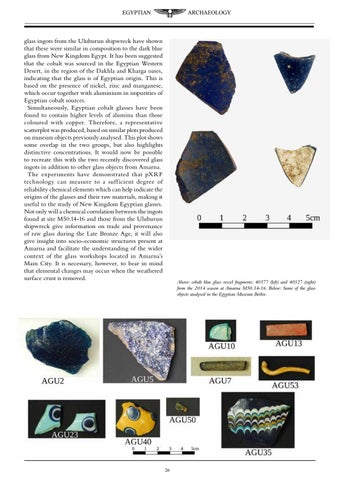
Above: cobalt blue glass vessel fragments: 40377 (left) and 40527 (right) from the 2014 season at Amarna M50.14-16. Below: Some of the glass objects analysed in the Egyptian Museum Berlin.
26