EGYPTIAN
ARCHAEOLOGY
the most accurately reflected due to their high atomic number. The periodic table of elementals (see p. 27) lists the elements that can and cannot be accurately detected using pXRF. The weathered surface was removed from four objects: one dark blue and one red glass rod, the fragment of a dark blue glass ingot, and the shard of an opaque dark blue glass vessel with polychrome decoration were selected. The chemical compounds that most significantly changed were silicon oxide and calcium oxide. Minor changes were detected in aluminium oxide, iron oxide and potassium oxide values. In order to verify the results of the pXRF analyses, the same four glass objects were analysed using a scanning electron microscope FEI Quanta 400, equipped with an X-ray spectrometer (SEM-EDX). Some differences between the results of the SEM-EDX and the pXRF were noted. However, copper oxide, phosphorus oxide, manganese, aluminium oxide, potassium oxide and titanium oxide and iron oxide proved to be either very or at least fairly reliably reflected using pXRF. The largest group of glass objects from Amarna are blue in colour, darker blue usually being derived from cobalt. Lighter blues are produced by adding copper, although this colourant can also produce darker blues, resulting
in hues almost equal to those developed using cobalt. These elements, together with antimony, a commonly used opacifier, can be traced very easily using pXRF. Laboratory-based analyses have demonstrated that a generally low potash content is present in Egyptian cobalt glasses as opposed to copper glasses. Mesopotamian glass, by contrast, has been found to contain much higher concentrations of potash, irrespective of colourants used – this most probably being linked to the regional differences in the plants used to produce the plant ash for the manufacture of glass. Analyses of some of the Keyword: X-ray fluorescence X-ray f luorescence ( X R F ) is a n a na ly t ica l technique based on the interaction of X-rays with a target material. Radiated, the material will emit characteristic ‘secondary’ (or fluorescent) X-rays, allowing to identify its elemental composition. The technique is non-destructive and thus well-suited to the analysis of rare or fragile artefacts. Museum curators, conservators and archaeologists may use it to gain information on an artefact, such as specific materials and techniques used in its manufacture, which in turn can suggest provenance or authenticity.
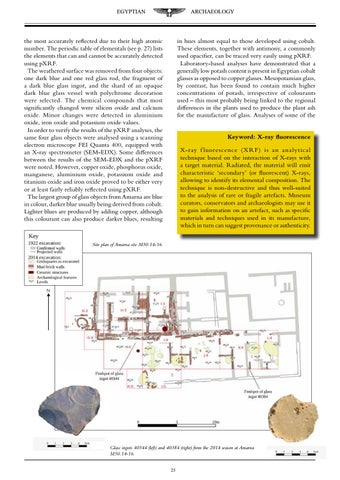
Site plan of Amarna site M50.14-16.
N
Glass ingots 40344 (left) and 40384 (right) from the 2014 season at Amarna M50.14-16. 25