EGYPTIAN
ARCHAEOLOGY
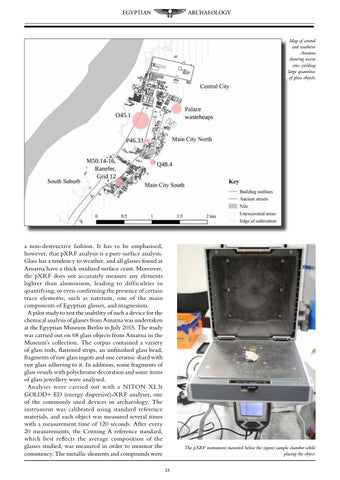
Map of central and southern Amarna showing recent sites yielding large quantities of glass objects.
a non-destructive fashion. It has to be emphasised, however, that pXRF analysis is a pure surface analysis. Glass has a tendency to weather, and all glasses found at Amarna have a thick oxidised surface crust. Moreover, the pXRF does not accurately measure any elements lighter than aluminium, leading to diff iculties in quantifying, or even confirming the presence of certain trace elements, such as natrium, one of the main components of Egyptian glasses, and magnesium. A pilot study to test the usability of such a device for the chemical analysis of glasses from Amarna was undertaken at the Egyptian Museum Berlin in July 2015. The study was carried out on 68 glass objects from Amarna in the Museum’s collection. The corpus contained a variety of glass rods, flattened strips, an unfinished glass bead, fragments of raw glass ingots and one ceramic shard with raw glass adhering to it. In addition, some fragments of glass vessels with polychrome decoration and some items of glass jewellery were analysed. Analyses were carried out with a NITON XL3t GOLDD+ ED (energy dispersive)-XRF analyser, one of the commonly used devices in archaeology. The instrument was calibrated using standard reference materials, and each object was measured several times with a measurement time of 120 seconds. After every 20 measurements, the Corning A reference standard, which best reflects the average composition of the glasses studied, was measured in order to monitor the consistency. The metallic elements and compounds were
The pXRF instrument mounted below the (open) sample chamber while placing the object. 24