EGYPTIAN
ARCHAEOLOGY
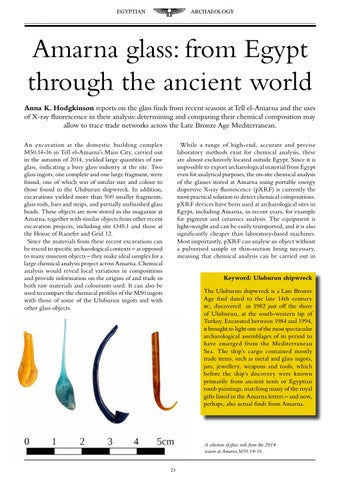
Amarna glass: from Egypt through the ancient world Anna K. Hodgkinson reports on the glass finds from recent seasons at Tell el-Amarna and the uses of X-ray fluorescence in their analysis: determining and comparing their chemical composition may allow to trace trade networks across the Late Bronze Age Mediterranean. An excavation at the domestic building complex M50.14-16 in Tell el-Amarna’s Main City, carried out in the autumn of 2014, yielded large quantities of raw glass, indicating a busy glass industry at the site. Two glass ingots, one complete and one large fragment, were found, one of which was of similar size and colour to those found in the Uluburun shipwreck. In addition, excavations yielded more than 500 smaller fragments, glass rods, bars and strips, and partially unfinished glass beads. These objects are now stored in the magazine at Amarna, together with similar objects from other recent excavation projects, including site O45.1 and those at the House of Ranefer and Grid 12. Since the materials from these recent excavations can be traced to specific archaeological contexts – as opposed to many museum objects – they make ideal samples for a large chemical analysis project across Amarna. Chemical analysis would reveal local variations in compositions and provide information on the origins of and trade in both raw materials and colourants used. It can also be used to compare the chemical profiles of the M50 ingots with those of some of the Uluburun ingots and with other glass objects.
While a range of high-end, accurate and precise laboratory methods exist for chemical analysis, these are almost exclusively located outside Egypt. Since it is impossible to export archaeological material from Egypt even for analytical purposes, the on-site chemical analysis of the glasses stored at Amarna using portable energy dispersive X-ray fluorescence (pXRF) is currently the most practical solution to detect chemical compositions. pXRF devices have been used at archaeological sites in Egypt, including Amarna, in recent years, for example for pigment and ceramics analysis. The equipment is light-weight and can be easily transported, and it is also significantly cheaper than laboratory-based machines. Most importantly, pXRF can analyse an object without a pulverised sample or thin-section being necessary, meaning that chemical analysis can be carried out in Keyword: Uluburun shipwreck The Uluburun shipwreck is a Late Bronze Age find dated to the late 14th century bc, discovered in 1982 just off the shore of Uluburun, at the south-western tip of Turkey. Excavated between 1984 and 1994, it brought to light one of the most spectacular archaeological assemblages of its period to have emerged from the Mediterranean Sea. The ship’s cargo contained mostly trade items, such as metal and glass ingots, jars, jewellery, weapons and tools, which before the ship’s discovery were known primarily from ancient texts or Egyptian tomb paintings, matching many of the royal gifts listed in the Amarna letters – and now, perhaps, also actual finds from Amarna.
A selection of glass rods from the 2014 season at Amarna M50.14-16.
23