EGYPTIAN
ARCHAEOLOGY
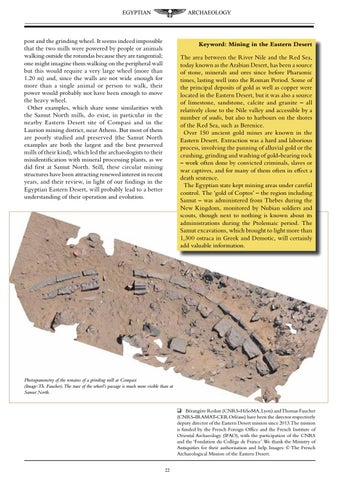
post and the grinding wheel. It seems indeed impossible that the two mills were powered by people or animals walking outside the rotundas because they are tangential; one might imagine them walking on the peripheral wall but this would require a very large wheel (more than 1.20 m) and, since the walls are not wide enough for more than a single animal or person to walk, their power would probably not have been enough to move the heavy wheel. Other examples, which share some similarities with the Samut North mills, do exist, in particular in the nearby Eastern Desert site of Compasi and in the Laurion mining district, near Athens. But most of them are poorly studied and preserved (the Samut North examples are both the largest and the best preserved mills of their kind), which led the archaeologists to their misidentification with mineral processing plants, as we did first at Samut North. Still, these circular mining structures have been attracting renewed interest in recent years, and their review, in light of our findings in the Egyptian Eastern Desert, will probably lead to a better understanding of their operation and evolution.
Keyword: Mining in the Eastern Desert The area between the River Nile and the Red Sea, today known as the Arabian Desert, has been a source of stone, minerals and ores since before Pharaonic times, lasting well into the Roman Period. Some of the principal deposits of gold as well as copper were located in the Eastern Desert, but it was also a source of limestone, sandstone, calcite and granite – all relatively close to the Nile valley and accessible by a number of wadis, but also to harbours on the shores of the Red Sea, such as Berenice. Over 150 ancient gold mines are known in the Eastern Desert. Extraction was a hard and laborious process, involving the panning of alluvial gold or the crushing, grinding and washing of gold-bearing rock – work often done by convicted criminals, slaves or war captives, and for many of them often in effect a death sentence. The Egyptian state kept mining areas under careful control. The ‘gold of Coptos’ – the region including Samut – was administered from Thebes during the New Kingdom, monitored by Nubian soldiers and scouts, though next to nothing is known about its administrations during the Ptolemaic period. The Samut excavations, which brought to light more than 1,300 ostraca in Greek and Demotic, will certainly add valuable information.
Photogrammetry of the remains of a grinding mill at Compasi (Image:Th. Faucher).The trace of the wheel’s passage is much more visible than at Samut North. Bérangère Redon (CNRS-HiSoMA, Lyon) and Thomas Faucher (CNRS-IRAMAT-CEB, Orléans) have been the director respectively deputy director of the Eastern Desert mission since 2013.The mission is funded by the French Foreign Office and the French Institute of Oriental Archaeology (IFAO), with the participation of the CNRS and the ‘Fondation du Collège de France’. We thank the Ministry of Antiquities for their authorisation and help. Images: © The French Archaeological Mission of the Eastern Desert. 22