EGYPTIAN
ARCHAEOLOGY
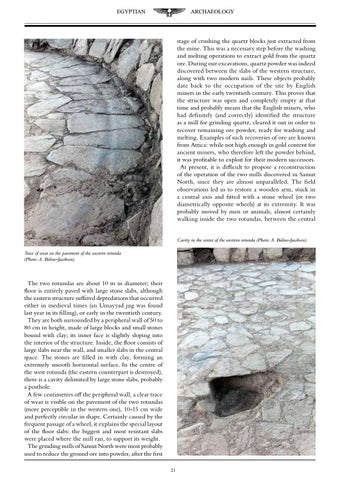
stage of crushing the quartz blocks just extracted from the mine. This was a necessary step before the washing and melting operations to extract gold from the quartz ore. During our excavations, quartz powder was indeed discovered between the slabs of the western structure, along with two modern nails. These objects probably date back to the occupation of the site by English miners in the early twentieth century. This proves that the structure was open and completely empty at that time and probably means that the English miners, who had definitely (and correctly) identified the structure as a mill for grinding quartz, cleared it out in order to recover remaining ore powder, ready for washing and melting. Examples of such recoveries of ore are known from Attica: while not high enough in gold content for ancient miners, who therefore left the powder behind, it was profitable to exploit for their modern successors. At present, it is difficult to propose a reconstruction of the operation of the two mills discovered in Samut North, since they are almost unparalleled. The field observations led us to restore a wooden arm, stuck in a central axis and fitted with a stone wheel (or two diametrically opposite wheels) at its extremity. It was probably moved by men or animals, almost certainly walking inside the two rotundas, between the central Cavity in the center of the western rotunda (Photo: A. BĂźlow-Jacobsen). Trace of wear on the pavement of the western rotunda (Photo: A. BĂźlow-Jacobsen).
The two rotundas are about 10 m in diameter; their floor is entirely paved with large stone slabs, although the eastern structure suffered depredations that occurred either in medieval times (an Umayyad jug was found last year in its filling), or early in the twentieth century. They are both surrounded by a peripheral wall of 50 to 80 cm in height, made of large blocks and small stones bound with clay; its inner face is slightly sloping into the interior of the structure. Inside, the floor consists of large slabs near the wall, and smaller slabs in the central space. The stones are filled in with clay, forming an extremely smooth horizontal surface. In the centre of the west rotunda (the eastern counterpart is destroyed), there is a cavity delimited by large stone slabs, probably a posthole. A few centimetres off the peripheral wall, a clear trace of wear is visible on the pavement of the two rotundas (more perceptible in the western one), 10-15 cm wide and perfectly circular in shape. Certainly caused by the frequent passage of a wheel, it explains the special layout of the floor slabs: the biggest and most resistant slabs were placed where the mill ran, to support its weight. The grinding mills of Samut North were most probably used to reduce the ground ore into powder, after the first 21