EGYPTIAN
ARCHAEOLOGY
A different approach was instead devised for the display of the tomb of Kha. This funerary assemblage, comprising over 450 objects, was almost entirely granted to the Turin Museum at the moment of the partage (the division of finds) with the Egyptian Antiquities Service in 1906. Schiaparelli’s original display showed the objects piled up in a small room to evoke their appearance at the time when the tomb was discovered, but this is clearly not an option for a modern museum with mass appeal. In this case, we decided to lay out the grave goods in ten large, freestanding showcases so as to maximize visibility, while recalling the original context of the artefacts through various means: the physical proximity of the Deir el-Medina hall, a video presentation with a 3D reconstruction of the burial, quotes from Schiaparelli’s description of the discovery, historical photos showing some of the objects as they were found, and keeping together sub-groups of originally associated objects whenever possible.
Dutch-Italian mission in the New Kingdom necropolis surrounding the tomb of Horemheb at Saqqara and to new collaborations with the Egyptian museums, such as the recent hosting of visiting curators from the NMEC (National Museum of Egyptian Civilization). Lastly, the museum visitors’ experience of the archaeological character of the collection has recently been expanded with the opening of new displays, the ‘Galleries of Material Culture’ distributed along the main route through the Museum, which offer a kind of open-storage access to many thousands of artefacts and fragments previously unseen.
The new display is far from being the only and final outcome of this process of renovation. The Museum is experimenting with new approaches to communication and outreach, and starting projects of social inclusion specifically aimed at the involvement of the North African and Senegalese communities residing in Turin. It is implementing restoration and research projects, seeking international collaborations, and launching a new programme for the publication of catalogue volumes. Moreover, since last year the Museum is strengthening its connection with Egypt through fieldwork, thanks to the participation in the joint
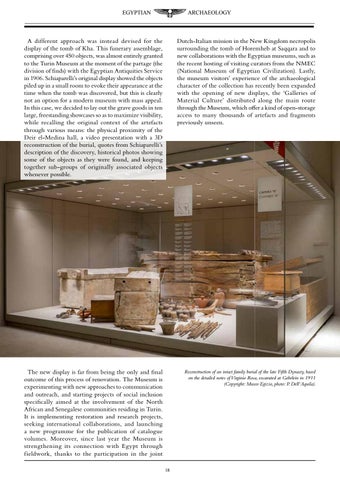
Reconstruction of an intact family burial of the late Fifth Dynasty, based on the detailed notes of Virginio Rosa, excavated at Gebelein in 1911 (Copyright: Museo Egizio, photo: P. Dell’Aquila).
18