EGYPTIAN
ARCHAEOLOGY
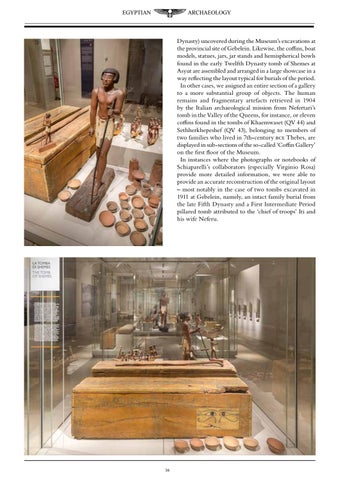
Dynasty) uncovered during the Museum’s excavations at the provincial site of Gebelein. Likewise, the coffins, boat models, statues, jars, jar stands and hemispherical bowls found in the early Twelfth Dynasty tomb of Shemes at Asyut are assembled and arranged in a large showcase in a way reflecting the layout typical for burials of the period. In other cases, we assigned an entire section of a gallery to a more substantial group of objects. The human remains and fragmentary artefacts retrieved in 1904 by the Italian archaeological mission from Nefertari’s tomb in the Valley of the Queens, for instance, or eleven coffins found in the tombs of Khaemwaset (QV 44) and Sethherkhepeshef (QV 43), belonging to members of two families who lived in 7th-century bce Thebes, are displayed in sub-sections of the so-called ‘Coffin Gallery’ on the first floor of the Museum. In instances where the photographs or notebooks of Schiaparelli’s collaborators (especially Virginio Rosa) provide more detailed information, we were able to provide an accurate reconstruction of the original layout – most notably in the case of two tombs excavated in 1911 at Gebelein, namely, an intact family burial from the late Fifth Dynasty and a First Intermediate Period pillared tomb attributed to the ‘chief of troops’ Iti and his wife Neferu.
16