EGYPTIAN
ARCHAEOLOGY
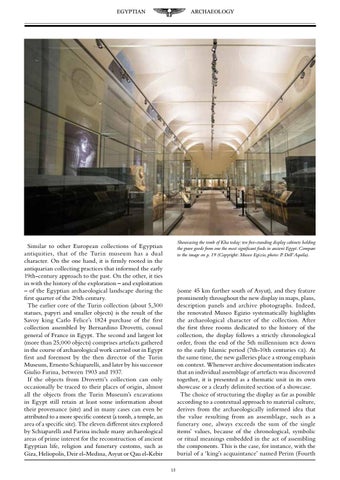
Showcasing the tomb of Kha today: ten free-standing display cabinets holding the grave goods from one the most significant finds in ancient Egypt. Compare to the image on p. 19 (Copyright: Museo Egizio, photo: P. Dell’Aquila).
Similar to other European collections of Egyptian antiquities, that of the Turin museum has a dual character. On the one hand, it is firmly rooted in the antiquarian collecting practices that informed the early 19th-century approach to the past. On the other, it ties in with the history of the exploration – and exploitation – of the Egyptian archaeological landscape during the first quarter of the 20th century. The earlier core of the Turin collection (about 5,300 statues, papyri and smaller objects) is the result of the Savoy king Carlo Felice’s 1824 purchase of the first collection assembled by Bernardino Drovetti, consul general of France in Egypt. The second and largest lot (more than 25,000 objects) comprises artefacts gathered in the course of archaeological work carried out in Egypt first and foremost by the then director of the Turin Museum, Ernesto Schiaparelli, and later by his successor Giulio Farina, between 1903 and 1937. If the objects from Drovetti’s collection can only occasionally be traced to their places of origin, almost all the objects from the Turin Museum’s excavations in Egypt still retain at least some information about their provenance (site) and in many cases can even be attributed to a more specific context (a tomb, a temple, an area of a specific site). The eleven different sites explored by Schiaparelli and Farina include many archaeological areas of prime interest for the reconstruction of ancient Egyptian life, religion and funerary customs, such as Giza, Heliopolis, Deir el-Medina, Asyut or Qau el-Kebir
(some 45 km further south of Asyut), and they feature prominently throughout the new display in maps, plans, description panels and archive photographs. Indeed, the renovated Museo Egizio systematically highlights the archaeological character of the collection. After the first three rooms dedicated to the history of the collection, the display follows a strictly chronological order, from the end of the 5th millennium bce down to the early Islamic period (7th-10th centuries ce). At the same time, the new galleries place a strong emphasis on context. Whenever archive documentation indicates that an individual assemblage of artefacts was discovered together, it is presented as a thematic unit in its own showcase or a clearly delimited section of a showcase. The choice of structuring the display as far as possible according to a contextual approach to material culture, derives from the archaeologically informed idea that the value resulting from an assemblage, such as a funerary one, always exceeds the sum of the single items’ values, because of the chronological, symbolic or ritual meanings embedded in the act of assembling the components. This is the case, for instance, with the burial of a ‘king’s acquaintance’ named Perim (Fourth 15