EGYPTIAN
ARCHAEOLOGY
Museo Egizio: framing archaeological context Celebrating its first anniversary since the inauguration of its renovated galleries in 2015, curator Paolo Del Vesco reveals the crucial role the Museo Egizio in Turin has played within field archaeology in Egypt.
The Museo Egizio in Turin houses one of the foremost Egyptological collections in the world. Its origins go back to the 17th century when the Savoy rulers began to collect Egyptian antiquities, eventually leading to the formal establishment of the museum. Today, it displays more than 13,000 objects, with a further 23,000 or so preserved in its storerooms. The renovation project aimed to transform what was to some extent still a 19th-century collection into a fully contemporary archaeological museum. Completed after three years, it doubled the museum’s display space to include all four floors of the late-17th-century building which has housed the Egyptian collection since the arrival of its first core in Turin around 1824. Three additional underground floors have been added, used to
house the building systems, storage and display spaces, as well as museum services (ticket office and bookshop). Throughout the restoration and renovation work, part of the collection, although relocated in temporary exhibition galleries within the museum building, was kept open to the public. With the arrival of a new director, Christian Greco, in April 2014 and the creation of a team of curators, the final plan for the new galleries was drawn up and implemented.
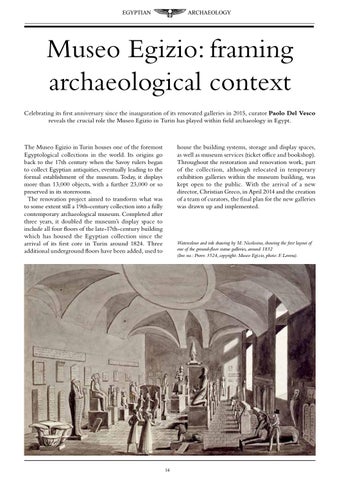
Watercolour and ink drawing by M. Nicolosino, showing the first layout of one of the ground-floor statue galleries, around 1832 (Inv. no.: Provv. 3524, copyright: Museo Egizio, photo: F. Lovera).
14