EGYPTIAN
ARCHAEOLOGY
chamber, and were cleaned, classified and grouped. An initial examination has now shown that the remains belong to three human skeletons and that of a small animal. According to Dr El-Merghani, Director of the MSA Research and Archaeological Conservation Centre, of the three human skeletons, one is male, another female, while the third was too badly damaged to identify without further conservation and restoration. The animal remains are those of a small dog. The male skeleton belonged to an individual aged 50 to 60 years, while the female would have been 40 to 50 years old. Next year, we intend to focus on architectural planning and survey, and the completion of epigraphic and photographic documentations. Conservation and restoration work will continue, including specialized analyses such as X-ray diffraction (XRD) for the identification of materials based on their crystalline structure, allowing us to examine building materials (limestone, plaster, mud brick), pigments and binding media. Fourier Transform Infrared Spectroscopy (FTIR) will be used to analyse organic compounds (e.g. food remains) Further study of the skeletal remains is needed to identify with certainty the skeletons’ gender, age, ancestry, height and possible pathologies. For this, the remains will need to be sent to the MSA Research and Archaeological Conservation Centre. Appropriate permissions from the MSA will be sought and all measures will be taken to ensure safe and secure transportation of the skeletal remains to the research centre. Pottery, ceramic, linen, ropes, palm petioles (midribs), stored in rooms VII, VIII and IX, will be analysed during the next season. We will use radiocarbon dating to determine the age of some of the organic materials found inside the tomb, particularly the skeletal remains, linen and midribs, as well as other organic materials found in situ inside and outside the tomb. The presence of Ramesses II’s name in the tomb, as well as textual, iconographic and paleographic features, point to the reign of this king. Radiocarbon dating will help ascertain whether the skeletal remains do indeed date to the original (Ramesside) occupation of the tomb or derive from later reuse.
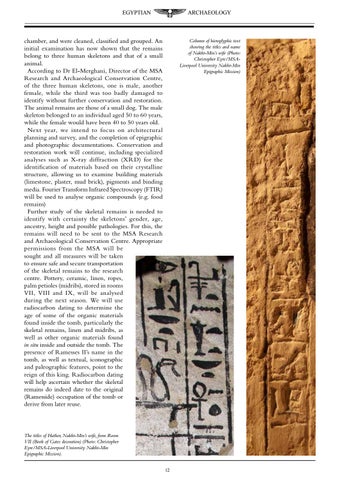
Column of hieroglyphic text showing the titles and name of Nakht-Min’s wife (Photo: Christopher Eyre/MSALiverpool University Nakht-Min Epigraphic Mission)
The titles of Hathor, Nakht-Min’s wife, from Room VII (Book of Gates decoration) (Photo: Christopher Eyre/MSA-Liverpool University Nakht-Min Epigraphic Mission). 12