EGYPTIAN
ARCHAEOLOGY
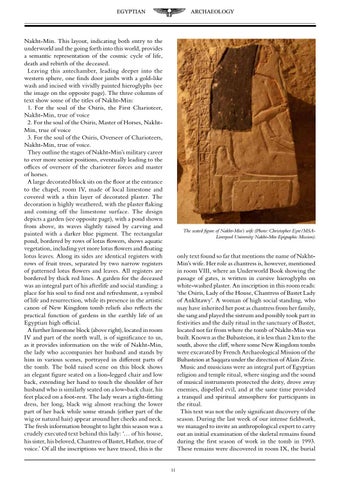
Nakht-Min. This layout, indicating both entry to the underworld and the going forth into this world, provides a semantic representation of the cosmic cycle of life, death and rebirth of the deceased. Leaving this antechamber, leading deeper into the western sphere, one finds door jambs with a gold-like wash and incised with vividly painted hieroglyphs (see the image on the opposite page). The three columns of text show some of the titles of Nakht-Min: 1. For the soul of the Osiris, the First Charioteer, Nakht-Min, true of voice 2. For the soul of the Osiris, Master of Horses, NakhtMin, true of voice 3. For the soul of the Osiris, Overseer of Charioteers, Nakht-Min, true of voice. They outline the stages of Nakht-Min’s military career to ever more senior positions, eventually leading to the offices of overseer of the charioteer forces and master of horses. A large decorated block sits on the floor at the entrance to the chapel, room IV, made of local limestone and covered with a thin layer of decorated plaster. The decoration is highly weathered, with the plaster flaking and coming off the limestone surface. The design depicts a garden (see opposite page), with a pond shown from above, its waves slightly raised by carving and painted with a darker blue pigment. The rectangular pond, bordered by rows of lotus flowers, shows aquatic vegetation, including yet more lotus flowers and floating lotus leaves. Along its sides are identical registers with rows of fruit trees, separated by two narrow registers of patterned lotus flowers and leaves. All registers are bordered by thick red lines. A garden for the deceased was an integral part of his afterlife and social standing: a place for his soul to find rest and refreshment, a symbol of life and resurrection, while its presence in the artistic canon of New Kingdom tomb reliefs also reflects the practical function of gardens in the earthly life of an Egyptian high official. A further limestone block (above right), located in room IV and part of the north wall, is of significance to us, as it provides information on the wife of Nakht-Min, the lady who accompanies her husband and stands by him in various scenes, portrayed in different parts of the tomb. The bold raised scene on this block shows an elegant figure seated on a lion-legged chair and low back, extending her hand to touch the shoulder of her husband who is similarly seated on a low-back chair, his feet placed on a foot-rest. The lady wears a tight-fitting dress, her long, black wig almost reaching the lower part of her back while some strands (either part of the wig or natural hair) appear around her cheeks and neck. The fresh information brought to light this season was a crudely executed text behind this lady: ‘… of his house, his sister, his beloved, Chantress of Bastet, Hathor, true of voice.’ Of all the inscriptions we have traced, this is the
The seated figure of Nakht-Min’s wife (Photo: Christopher Eyre/MSALiverpool University Nakht-Min Epigraphic Mission).
only text found so far that mentions the name of NakhtMin’s wife. Her role as chantress is, however, mentioned in room VIII, where an Underworld Book showing the passage of gates, is written in cursive hieroglyphs on white-washed plaster. An inscription in this room reads: ‘the Osiris, Lady of the House, Chantress of Bastet Lady of Ankhtawy’. A woman of high social standing, who may have inherited her post as chantress from her family, she sang and played the sistrum and possibly took part in festivities and the daily ritual in the sanctuary of Bastet, located not far from where the tomb of Nakht-Min was built. Known as the Bubasteion, it is less than 2 km to the south, above the cliff, where some New Kingdom tombs were excavated by French Archaeological Mission of the Bubasteion at Saqqara under the direction of Alain Zivie. Music and musicians were an integral part of Egyptian religion and temple ritual, where singing and the sound of musical instruments protected the deity, drove away enemies, dispelled evil, and at the same time provided a tranquil and spiritual atmosphere for participants in the ritual. This text was not the only significant discovery of the season. During the last week of our intense fieldwork, we managed to invite an anthropological expert to carry out an initial examination of the skeletal remains found during the first season of work in the tomb in 1993. These remains were discovered in room IX, the burial 11