EGYPTIAN
ARCHAEOLOGY
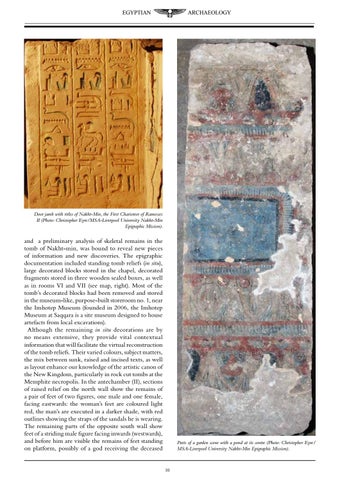
Door jamb with titles of Nakht-Min, the First Charioteer of Ramesses II (Photo: Christopher Eyre/MSA-Liverpool University Nakht-Min Epigraphic Mission).
and a preliminary analysis of skeletal remains in the tomb of Nakht-min, was bound to reveal new pieces of information and new discoveries. The epigraphic documentation included standing tomb reliefs (in situ), large decorated blocks stored in the chapel, decorated fragments stored in three wooden sealed boxes, as well as in rooms VI and VII (see map, right). Most of the tomb’s decorated blocks had been removed and stored in the museum-like, purpose-built storeroom no. 1, near the Imhotep Museum (founded in 2006, the Imhotep Museum at Saqqara is a site museum designed to house artefacts from local excavations). Although the remaining in situ decorations are by no means extensive, they provide vital contextual information that will facilitate the virtual reconstruction of the tomb reliefs. Their varied colours, subject matters, the mix between sunk, raised and incised texts, as well as layout enhance our knowledge of the artistic canon of the New Kingdom, particularly in rock cut tombs at the Memphite necropolis. In the antechamber (II), sections of raised relief on the north wall show the remains of a pair of feet of two figures, one male and one female, facing eastwards: the woman’s feet are coloured light red, the man’s are executed in a darker shade, with red outlines showing the straps of the sandals he is wearing. The remaining parts of the opposite south wall show feet of a striding male figure facing inwards (westwards), and before him are visible the remains of feet standing on platform, possibly of a god receiving the deceased
Parts of a garden scene with a pond at its centre (Photo: Christopher Eyre/ MSA-Liverpool University Nakht-Min Epigraphic Mission).
10