EGYPTIAN
ARCHAEOLOGY
Nakht-Min: Ramesses II’s charioteer and envoy Khaled Daoud, Sabry Farag and Christopher Eyre report on the last season at the tomb of Nakht-Min at the Memphite necropolis at Abusir, supported by the Egypt Exploration Society through a fieldwork and research grant. At the bottom of a cliff overlooking the village of Abusir, the tomb of the Nineteenth-Dynasty official Nakht-Min, the ‘First Charioteer of His Majesty’ and ‘Royal Envoy to All Foreign Lands’, stands very close to some random and unplanned modern houses, which are probably in fact built over land containing numerous antique remains. The rock-cut tomb, which was originally found by local antiques hunters over two decades ago, and subsequently properly excavated by a team of Egyptian archaeologists, is now undergoing documentation by a team of Egyptian-British experts. Connected to his role as charioteer, Nakht-Min was Overseer of Horses, probably in charge of their grooming, training, feeding and general well-being: charioteers formed an army division, first introduced during the Second Intermediate Period. Nakht-Min was also the First Charioteer of his Majesty, a modifier phrase that indicates the close association he enjoyed with Ramesses II. Like many in his position, Nakht-Min also took on diplomatic roles, serving as royal envoy to all foreign lands, leading ambassadorial missions to Egypt’s neighbouring states on an ad hoc basis. That function had earlier also been carried out by the likes of Horemheb and Paramessu (Ramesses I), who eventually became rulers of Egypt – the first leading the country during a very critical period of its history, the second establishing a new line of rulers, ushering in the Ramesside era of pharaonic Egypt. The escarpment where the tomb is located is a promising archaeological area, and most likely part of a larger cemetery of the Ramesside era, a period characterised by internal and external political conflicts, as well as societal, religious, architectural, artistic, and textual evolution and innovations. The cliff itself is located at the foot of the hill that accommodates the major First- and Second-Dynasty tombs. About 25 km south-west of Cairo, it lies at the southern end of the area traditionally known as the Abusir Cemetery: an extension and continuation of Saqqara and an integral part of the larger Memphite necropolis. The range of remains from various periods found at Abusir over the last 40 years – most recently by the Czech Institute of
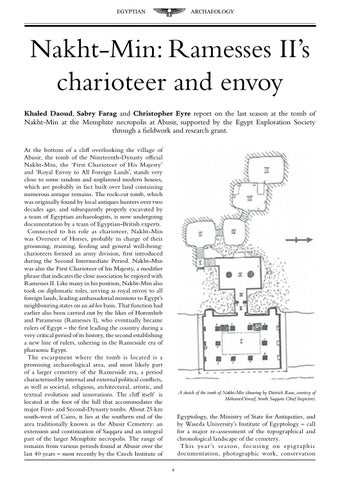
A sketch of the tomb of Nakht-Min (drawing by Dietrich Raue, courtesy of Mohamed Yousef, South Saqqara Chief Inspector).
Egyptology, the Ministry of State for Antiquities, and by Waseda University’s Institute of Egyptology – call for a major re-assessment of the topographical and chronological landscape of the cemetery. T h i s ye a r’s se a son , foc u s i n g on epi g r aph ic documentation, photographic work, conservation 9