EGYPTIAN
ARCHAEOLOGY
Signs in stone: archaeological research at Gebelein The first season of research revealed previously unknown graffiti and tombs as well as the urgent need to undertake salvage missions at Gebelein, Wojciech Ejsmond writes. Recently, new research has been initiated by a team from the University of Warsaw at the archaeological complex of Gebelein. Virtually all periods of Egyptian history have left their traces here and it is representative of almost every kind of archaeological sites found in the Nile valley. Gebelein played an important role in the history of ancient Egypt. In the Predynastic Period, people of very high social status – probably rulers of a
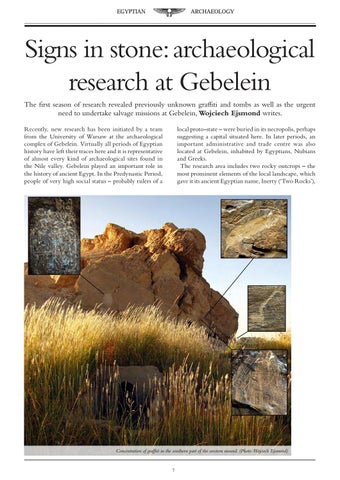
local proto-state – were buried in its necropolis, perhaps suggesting a capital situated here. In later periods, an important administrative and trade centre was also located at Gebelein, inhabited by Egyptians, Nubians and Greeks. The research area includes two rocky outcrops – the most prominent elements of the local landscape, which gave it its ancient Egyptian name, Inerty (‘Two Rocks’),
Concentration of graffiti in the southern part of the western mound. (Photo:Wojciech Ejsmond)
7