EGYPTIAN
ARCHAEOLOGY
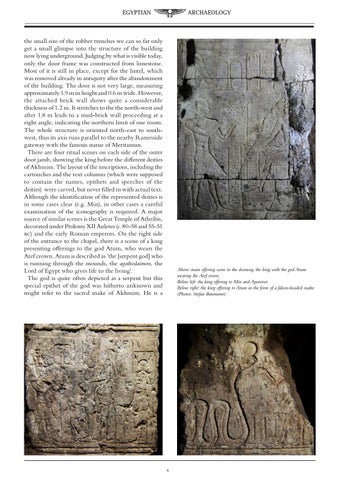
the small size of the robber trenches we can so far only get a small glimpse into the structure of the building now lying underground. Judging by what is visible today, only the door frame was constructed from limestone. Most of it is still in place, except for the lintel, which was removed already in antiquity after the abandonment of the building. The door is not very large, measuring approximately 1.9 m in height and 0.6 m wide. However, the attached brick wall shows quite a considerable thickness of 1.2 m. It stretches to the the north-west and after 1.8 m leads to a mud-brick wall proceeding at a right angle, indicating the northern limit of one room. The whole structure is oriented north-east to southwest, thus its axis runs parallel to the nearby Ramesside gateway with the famous statue of Meritamun. There are four ritual scenes on each side of the outer door jamb, showing the king before the different deities of Akhmim. The layout of the inscriptions, including the cartouches and the text columns (which were supposed to contain the names, epithets and speeches of the deities) were carved, but never filled in with actual text. Although the identification of the represented deities is in some cases clear (e.g. Min), in other cases a careful examination of the iconography is required. A major source of similar scenes is the Great Temple of Athribis, decorated under Ptolemy XII Auletes (c. 80-58 and 55-51 bc) and the early Roman emperors. On the right side of the entrance to the chapel, there is a scene of a king presenting offerings to the god Atum, who wears the Atef crown. Atum is described as ‘the [serpent god] who is running through the mounds, the agathodaimon, the Lord of Egypt who gives life to the living’. The god is quite often depicted as a serpent but this special epithet of the god was hitherto unknown and might refer to the sacred snake of Akhmim. He is a
Above: main offering scene in the doorway, the king with the god Atum wearing the Atef crown. Below left: the king offering to Min and Aperetset. Below right: the king offering to Atum in the form of a falcon-headed snake. (Photos: Stefan Baumann)
4