EGYPTIAN
ARCHAEOLOGY
known as the donor of the homoerotic ‘Warren Cup’ in the British Museum), thence to the Boston Museum of Fine Arts where it now enjoys considerable fame. As Berman points out, it is easy to forget the head once was attached to a body. Had the statue survived intact it is unlikely to have received such acclaim. In its detached state, modern attention is focussed on the face; indeed, the realism of the countenance (whether or not it was intended to represent a unique, living individual) was probably an ancient means to attract attention to the sculpture, and thus increase desired interaction with living temple staff. Berman’s book is to be highly recommended for the different (often very colourful) stories behind this incredible face that it throws into relief. Imagine how many other stories like this await the telling! CAMPBELL PRICE
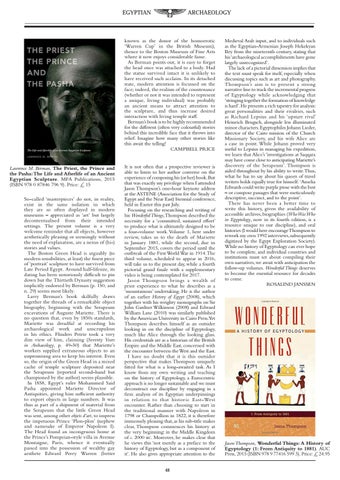
Lawrence M. Berman, The Priest, the Prince and the Pasha: The Life and Afterlife of an Ancient Egyptian Sculpture. MFA Publications, 2015 (ISBN 978 0 87846 796 9). Price: £ 15 So-called ‘masterpieces’ do not, in reality, exist in the same isolation in which they are so often displayed in modern museums – appreciated as ‘art’ but largely decontextualised from their intended settings. The present volume is a very welcome reminder that all objects, however aesthetically pleasing or seemingly without the need of explanation, are a nexus of (hi-) stories and values. The Boston Green Head is arguably (to modern sensibilities, at least) the finest piece of ‘portrait’ sculpture to have survived from Late Period Egypt. Around half-lifesize, its dating has been notoriously difficult to pin down but the Thirtieth Dynasty suggestion implicitly endorsed by Berman (p. 150, and n. 29) seems most likely. Larry Berman’s book skilfully draws together the threads of a remarkable object biography, beginning with the Serapeum excavations of Auguste Mariette. There is no question that, even by 1850s standards, Mariette was dreadful at recording his archaeological work and unscrupulous in his ethics. Flinders Petrie took a very dim view of him, claiming (Seventy Years in Archaeology, p. 49-50) that Mariette’s workers supplied extraneous objects to an unpromising area to keep his interest. Even so, the origin of the Green Head in a mixed cache of temple sculpture deposited near the Serapeum (reported second-hand but championed by the author) seems plausible. In 1858, Egypt’s ruler Mohammed Said Pasha appointed Mariette Director of Antiquities, giving him sufficient authority to export objects in large numbers. It was thus as part of a shipment of material from the Serapeum that the little Green Head was sent, among other objets d’art, to impress the impetuous Prince ‘Plon-plon’ (nephew and namesake of Emperor Napoleon I). The Head found an incongruous home at the Prince’s Pompeian-style villa in Avenue Montaigne, Paris, whence it eventually passed into the possession of wealthy gay aesthete Edward Perry Warren (better
It is not often that a prospective reviewer is able to listen to her author converse on the experience of composing his (or her) book. But that was exactly my privilege when I attended Jason Thompson’s one-hour keynote address at the ASTENE (Association for the Study of Egypt and the Near East) biennial conference, held in Exeter this past July. Focusing on the researching and writing of his Wonderful Things, Thompson described the necessity for a ‘committed, sustained effort’ to produce what is ultimately designed to be a four-volume work. Volume 1, here under review, takes us to the death of Mariette in January 1881, while the second, due in September 2015, covers the period until the outbreak of the First World War in 1914. The third volume, scheduled to appear in 2016, will take us to the present day, while a fourth pictorial grand finale with a supplementary video is being contemplated for 2017. Jason Thompson br ings a wealth of prior experience to what he describes as a ‘mountainous’ undertaking. He is the author of an earlier History of Egypt (2008), which together with his weighty monographs on Sir John Gardner Wilkinson (2008) and Edward William Lane (2010) was similarly published by the American University in Cairo Press.Yet Thompson describes himself as an outsider looking in on the discipline of Egyptology, much like Alice through the looking glass. His credentials are as a historian of the British Empire and the Middle East, concerned with the encounter between the West and the East. I have no doubt that it is this outsider perspective that makes Thompson uniquely fitted for what is a long-awaited task. As I know from my own writing and teaching on the history of Egyptology, a Eurocentric approach is no longer sustainable and we must deconstruct our discipline by engaging in a firm analysis of its Egyptian underpinnings in relation to that histor ic East-West encounter. Rather than choosing to start in the traditional manner with Napoleon in 1798 or Champollion in 1822, it is therefore immensely pleasing that, as his sub-title makes clear, Thompson commences his history at the very beginning: in the Middle Kingdom of c. 2000 bc. Moreover, he makes clear that he views this ‘not merely as a preface to the history of Egyptology, but as a component of it’. He also gives appropriate attention to the 48
Medieval Arab input, and to individuals such as the Egyptian-Armenian Joseph Hekekyan Bey from the nineteenth century, stating that his ‘archaeological accomplishments have gone largely unrecognized’. The lack of a pictorial dimension implies that the text must speak for itself, especially when discussing topics such as art and photography. Thompson’s aim is to present a strong narrative line to track the incremental progress of Egyptology while acknowledging that ‘stringing together the formation of knowledge is hard’. He presents a rich tapestry for analysis: great personalities and their rivalries, such as Richard Lepsius and his ‘upstart rival’ Heinrich Brugsch, alongside less illuminated minor characters. Egyptophiles Johann Lieder, director of the Cairo mission of the Church Missionary Society, and his wife Alice are a case in point. While Johann proved very useful to Lepsius in managing his expedition, we learn that Alice’s ‘investigations at Saqqara may have come close to anticipating Mariette’s discovery of the Serapeum’. Thompson is aided throughout by his ability to write.Thus, what he has to say about his queen of travel writers holds equally true for himself: ‘Amelia Edwards could write purple prose with the best – or compose passages that were meticulously descriptive, succinct, and to the point’. There has never been a better time to write this history, given the availability of accessible archives, biographies (Who Was Who in Egyptology, now in its fourth edition, is a resource unique to our discipline), and oral histories (I would here encourage Thompson to rework my own 1992 interviews, subsequently digitized by the Egypt Exploration Society). While no history of Egyptology can ever hope to be complete, and individual countries and institutions must set about compiling their own narratives, we await with anticipation the follow-up volumes. Wonderful Things deserves to become the essential resource for decades to come. ROSALIND JANSSEN
Jason Thompson, Wonderful Things: A History of Egyptology (1: From Antiquity to 1881). AUC Press, 2015 (ISBN 978 9 77416 599 3). Price: £ 24.95