EGYPTIAN
ARCHAEOLOGY
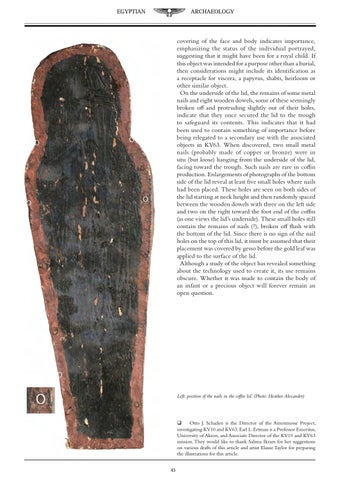
covering of the face and body indicates importance, emphasizing the status of the individual portrayed, suggesting that it might have been for a royal child. If this object was intended for a purpose other than a burial, then considerations might include its identification as a receptacle for viscera, a papyrus, shabti, heirloom or other similar object. On the underside of the lid, the remains of some metal nails and eight wooden dowels, some of these seemingly broken off and protruding slightly out of their holes, indicate that they once secured the lid to the trough to safeguard its contents. This indicates that it had been used to contain something of importance before being relegated to a secondary use with the associated objects in KV63. When discovered, two small metal nails (probably made of copper or bronze) were in situ (but loose) hanging from the underside of the lid, facing toward the trough. Such nails are rare in coffin production. Enlargements of photographs of the bottom side of the lid reveal at least five small holes where nails had been placed. These holes are seen on both sides of the lid starting at neck height and then randomly spaced between the wooden dowels with three on the left side and two on the right toward the foot end of the coffin (as one views the lid’s underside). These small holes still contain the remains of nails (?), broken off flush with the bottom of the lid. Since there is no sign of the nail holes on the top of this lid, it must be assumed that their placement was covered by gesso before the gold leaf was applied to the surface of the lid. Although a study of the object has revealed something about the technology used to create it, its use remains obscure. Whether it was made to contain the body of an infant or a precious object will forever remain an open question.
Left: position of the nails in the coffin lid. (Photo: Heather Alexander)
ď ą Otto J. Schaden is the Director of the Amenmesse Project, investigating KV10 and KV63. Earl L. Ertman is a Professor Emeritus, University of Akron, and Associate Director of the KV10 and KV63 mission. They would like to thank Salima Ikram for her suggestions on various drafts of this article and artist Elaine Taylor for preparing the illustrations for this article. 45