EGYPTIAN
ARCHAEOLOGY
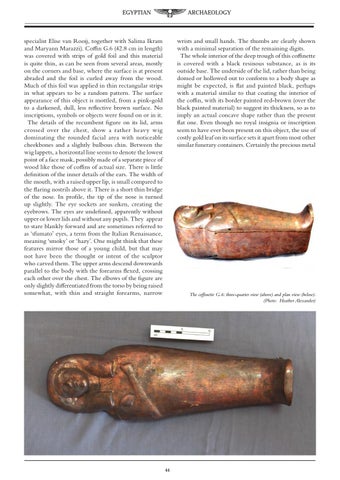
specialist Elise van Rooij, together with Salima Ikram and Maryann Marazzi). Coffin G.6 (42.8 cm in length) was covered with strips of gold foil and this material is quite thin, as can be seen from several areas, mostly on the corners and base, where the surface is at present abraded and the foil is curled away from the wood. Much of this foil was applied in thin rectangular strips in what appears to be a random pattern. The surface appearance of this object is mottled, from a pink-gold to a darkened, dull, less reflective brown surface. No inscriptions, symbols or objects were found on or in it. The details of the recumbent figure on its lid, arms crossed over the chest, show a rather heavy wig dominating the rounded facial area with noticeable cheekbones and a slightly bulbous chin. Between the wig lappets, a horizontal line seems to denote the lowest point of a face mask, possibly made of a separate piece of wood like those of coffins of actual size. There is little definition of the inner details of the ears. The width of the mouth, with a raised upper lip, is small compared to the flaring nostrils above it. There is a short thin bridge of the nose. In profile, the tip of the nose is turned up slightly. The eye sockets are sunken, creating the eyebrows. The eyes are undefined, apparently without upper or lower lids and without any pupils. They appear to stare blankly forward and are sometimes referred to as ‘sfumato’ eyes, a term from the Italian Renaissance, meaning ‘smoky’ or ‘hazy’. One might think that these features mirror those of a young child, but that may not have been the thought or intent of the sculptor who carved them. The upper arms descend downwards parallel to the body with the forearms flexed, crossing each other over the chest. The elbows of the figure are only slightly differentiated from the torso by being raised somewhat, with thin and straight forearms, narrow
wrists and small hands. The thumbs are clearly shown with a minimal separation of the remaining digits. The whole interior of the deep trough of this coffinette is covered with a black resinous substance, as is its outside base. The underside of the lid, rather than being domed or hollowed out to conform to a body shape as might be expected, is flat and painted black, perhaps with a material similar to that coating the interior of the coffin, with its border painted red-brown (over the black painted material) to suggest its thickness, so as to imply an actual concave shape rather than the present flat one. Even though no royal insignia or inscription seem to have ever been present on this object, the use of costly gold leaf on its surface sets it apart from most other similar funerary containers. Certainly the precious metal
The coffinette G.6: three-quarter view (above) and plan view (below). (Photo: Heather Alexander)
44