EGYPTIAN
ARCHAEOLOGY
In the courtyard, below the Third Intermediate Period horizon, a stratum of about 45 cm of debris was found. Mixed in, together with large rocks and boulders, were a great number of fragments of sandstone, hundreds of which are decorated, deriving from the New Kingdom courtyard structure. The destruction of the Ramesside courtyard, perhaps by a large rockfall, occurred prior to the Third Intermediate Period since the western side of the southern shaft cut through the sandstone foundation blocks of the west courtyard wall. It is of note that the sandstone architectural fragments found were relatively small in size, suggesting that any large reusable blocks had been removed.
and cushion from a window of appearances (an opening in the façade of a palace where the pharaoh would show himself on the occasion of public ceremonies). Such a scene would have commemorated an important event in the life of Amenmose, either an appointment to office or the bestowal of a reward, and highlights Amenmose’s close connection with the king. This is also documented by the text on another fragment: ‘[Osiris] the true royal scribe, his beloved, Attendant of [the Lord of the Two Lands / the King / the Good God / the Sovereign]’. This title is regularly held by men of high office who were close to the sovereign. The qualification ‘true’ with ‘royal scribe’ most probably indicates that he was in the personal service of the king, a conclusion backed by a title inside the tomb, ‘Head of the King’s Entire Estate’. Boyo Ockinga is an Associate Professor in the Department of Ancient History and member of the Ancient Cultures Research Centre at Macquarie University. Since 1984 he has conducted regular fieldwork projects in Egypt at a number of sites – Nag El Mashayikh, Awlad Azzaz (Sohag), Dra Abu el-Naga (Luxor) and Saqqara. Since 1991 he has directed the Macquarie Theban Tombs Project at Dra Abu el-Naga.
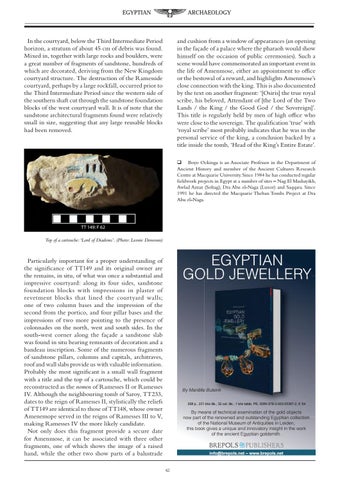
Top of a cartouche: ‘Lord of Diadems’. (Photo: Leonie Donovan)
EGYPTIAN GOLD JEWELLERY
Particularly important for a proper understanding of the significance of TT149 and its original owner are the remains, in situ, of what was once a substantial and impressive courtyard: along its four sides, sandstone foundation blocks with impressions in plaster of revetment blocks that lined the courtyard walls; one of two column bases and the impression of the second from the portico, and four pillar bases and the impressions of two more pointing to the presence of colonnades on the north, west and south sides. In the south-west corner along the façade a sandstone slab was found in situ bearing remnants of decoration and a bandeau inscription. Some of the numerous fragments of sandstone pillars, columns and capitals, architraves, roof and wall slabs provide us with valuable information. Probably the most significant is a small wall fragment with a title and the top of a cartouche, which could be reconstructed as the nomen of Ramesses II or Ramesses IV. Although the neighbouring tomb of Saroy, TT233, dates to the reign of Ramesses II, stylistically the reliefs of TT149 are identical to those of TT148, whose owner Amenemope served in the reigns of Ramesses III to V, making Ramesses IV the more likely candidate. Not only does this fragment provide a secure date for Amenmose, it can be associated with three other fragments, one of which shows the image of a raised hand, while the other two show parts of a balustrade
By Mariëlle Bulsink 208 p., 221 b/w ills., 32 col. ills., 1 b/w table, PB, ISBN 978-2-503-55367-2, € 64
By means ans of technical examination of the gold objects now part of the renowned and outstanding Egyptian collection of the National Museum of Antiquities in Leiden, this book gives a unique and innovatory insight in the work of the ancient Egyptian goldsmith.
info@brepols.net – www.brepols.net
42